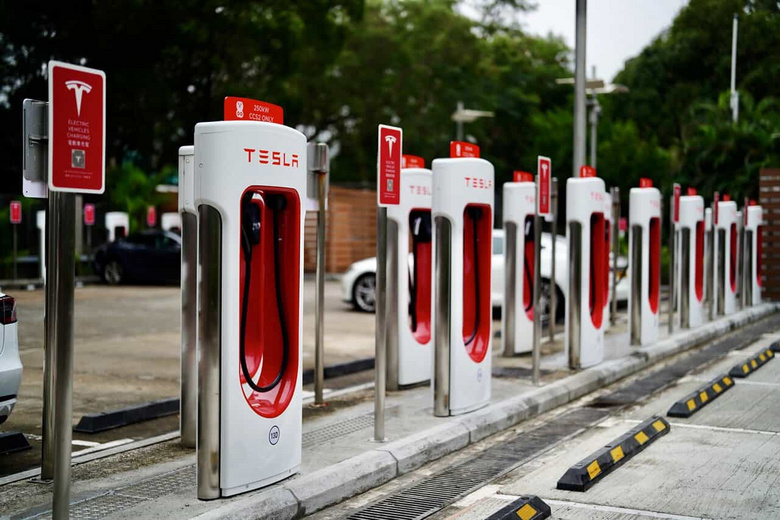
Recently, Tesla announced on social media platform X that it will trial a virtual queue system in the upcoming second quarter, optimizing its Supercharger stations to meet the charging demands of high-density cities like Hong Kong. Although Tesla’s Supercharger is extremely fast, it can still take over half an hour to fully charge during peak demand times, leading to long wait times and frustrating disputes among electric vehicle owners.
Tesla has stated that while long queues at charging stations in busy areas are not common, when they do occur, they often lead to unpleasant situations among drivers. For instance, some drivers may believe they arrived first, only to find someone cutting in line. This conflict not only troubles the drivers but could also pose issues for social order.
The introduction of a virtual queue system theoretically ensures better queue management, thereby reducing conflicts arising from disputes over positions. However, Tesla acknowledges that some owners may still ignore the system’s rules, which could lead to more unnecessary friction.
At the same time, Tesla is expanding its Supercharger network, planning to grow by over 20% each year to better meet the surging demand for charging. As other brands’ electric vehicles gain access to Tesla charging stations, these challenges are expected to increase. Tesla’s goal is to minimize wait times by increasing the number of charging stations.
As for whether the virtual queue system can be compatible with non-Tesla electric vehicles, there is currently no clear answer, and this will be one of the key issues to watch in the future. During the trial period, Tesla will actively gather user feedback to determine whether to promote this innovative system.
This new initiative aims to improve the charging order in busy areas like Hong Kong, but the actual effectiveness will depend on how well the pilot program is implemented. There is still uncertainty about whether a virtual queuing system can be introduced in Hong Kong.