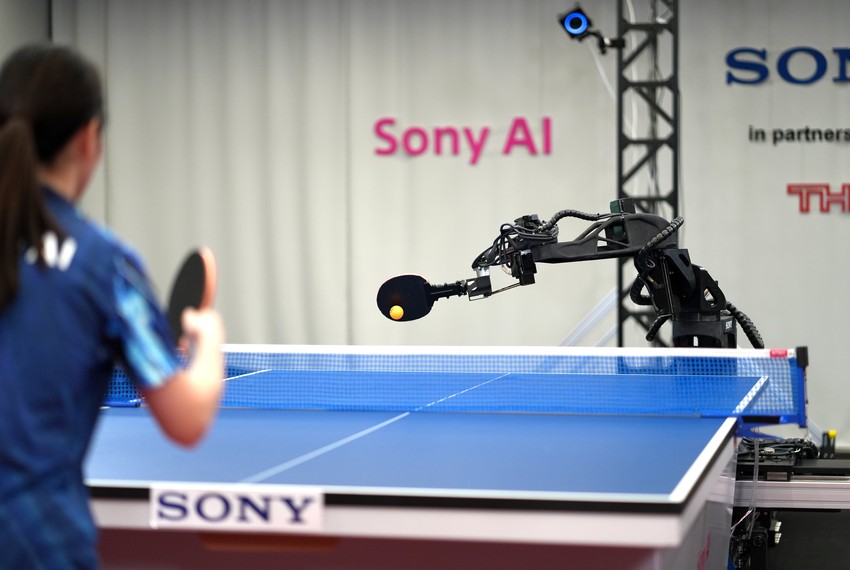
Sony AI Ace uses nine active pixel sensor cameras and reinforcement learning to return balls within milliseconds, and it defeated elite players in internal tests, demonstrating how fast AI can learn in the physical world.
The most striking thing about Sony AI Ace is not that it looks human, but that it keeps an exposed, laboratory style. Sensors, the robot arm, and the paddle are not hidden behind a consumer style shell, which makes the technical trade offs visible: vision, balance compensation, and striking angle correction must close the loop in a few milliseconds.
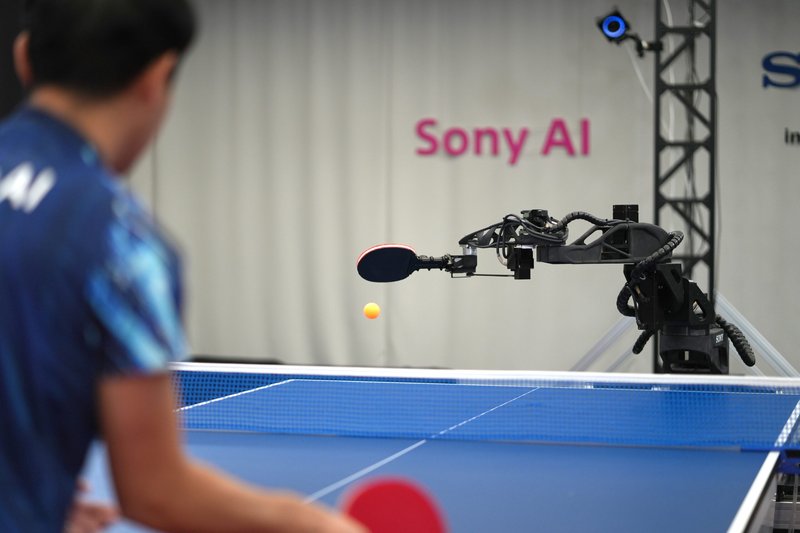
Sony AI Ace vision and sensing
Ace is fitted with nine active pixel sensor cameras that track the ball in three dimensional space, while additional sensors estimate speed and spin, Sony AI said. The system uses reinforcement learning that does not rely on a fixed model, so the robot does not follow a catalog of pre programmed strokes but adapts its returns to the incoming ball quality in real time.
Table tennis is a brutal test bed, because ball speed, spin, paddle angle, and court bounce all change every second. That variability makes this task much more complex than an industrial arm repeating parts handling at a fixed station.
Test results and what they prove
Sony AI said Ace was tested against five elite players and two professionals, and in five matches with elite opponents it won three. In the trial, Ace scored 16 direct service points, compared with the players’ eight, Sony AI said.
Those figures matter because they suggest AI strengths are moving beyond screens of text, images, and code into a world full of friction, latency, and uncertainty. Physical tasks force perception and control systems to work together at millisecond timescales.
Productization strategy and commercial path
Architecturally, Sony AI Ace does not have to solve bipedal balance or dexterous fingers, nor meet home safety regulations before it demonstrates capability. That lets developers focus spending on high speed vision, joint rigidity, and control algorithms. The approach is a pragmatic productization prelude: first exceed human performance in one hard scenario, then decompose and reuse modules for logistics, rehabilitation, manufacturing, and training.
Readers in Hong Kong may not see Sony AI Ace at a club soon, but the signal from this demo is clear. When AI can read spin, predict landing points, and return a backhand, it is no longer only a laboratory curiosity; it becomes a factor in how services and training labor are organized.
Will the next time AI beats a human be at the table, or in your workplace?