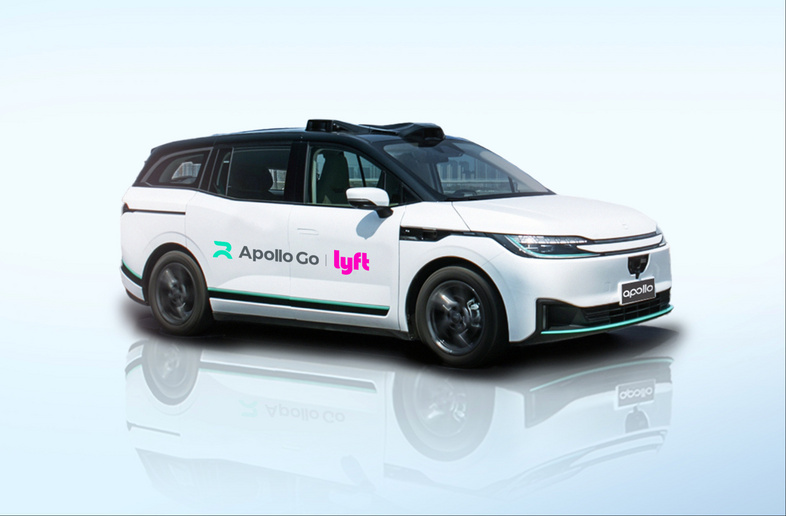
Baidu's subsidiary, Luobo Kuaipao, has formed a strategic partnership with the well-known ride-hailing platform Lyft, planning to promote autonomous driving services across Europe using Lyft's platform. In the near future, the two companies are expected to first launch the deployment of Luobo Kuaipao's sixth-generation autonomous vehicles in Germany and the UK, gradually expanding to thousands of vehicles to achieve large-scale operations of self-driving technology.
According to the cooperation agreement, Luobo Kuairun will leverage the Lyft platform to provide autonomous ride-hailing services for users in Europe. This partnership not only marks the first large-scale entry of Chinese autonomous driving technology into the European market but also represents an important milestone in Luobo Kuairun's global strategy. Users can directly book autonomous vehicles through the Lyft app, making travel options more convenient.
Lyft's CEO David Risher has stated that Baidu's autonomous driving ride-hailing platform boasts the most extensive scale globally. Their wealth of experience means they can offer European users a safe, reliable, and privacy-conscious autonomous ride-hailing service. This collaboration is part of LyftHuman-Machine Collaborative Ride-Hailing Network's strategy, highlighting the synergy between autonomous vehicles and human drivers.
Baidu's founder, Li Yanhong, emphasized that the partnership with Lyft to launch self-driving services marks a significant breakthrough for Luobo Kuaipao in its global strategy. He stated that Baidu will continue to push for the integration of autonomous driving technology with Lyft's delivery experience, aiming to offer this innovative service to users all around the world.
Industry analysis indicates that Europe boasts advanced road infrastructure and a highly digitalized social environment, creating favorable conditions for the implementation of autonomous driving technology. As a leading global ride-hailing platform, Lyft's expertise in fleet management, user operations, and localization will maximize the benefits of cooperation between the two parties.
The sixth-generation Robotaxi is equipped with the latest autonomous driving technology, featuring high-precision sensors, an AI decision-making system, and safety redundancy designs. This allows it to adapt to Europe's complex road environments, whether navigating through narrow ancient streets or cruising on highways, and it can operate steadily even under varying weather conditions.
The partnership will unfold in phases, starting with small-scale pilot programs in Germany and the UK to test the adaptability of the technology and gauge user acceptance. Following this, the plan is to expand into other major European cities, aiming for a deployment scale of thousands of vehicles in the coming years. Lyft will actively collaborate with local regulatory bodies to ensure that the deployment of vehicles is carried out prudently.
This year, Luobo Kuaipao has accelerated its global expansion, launching operations in Dubai, Abu Dhabi, and other locations. Recently, Luobo Kuaipao entered into a partnership with the world's largest ride-hailing platform, Uber, planning to deploy thousands of autonomous vehicles across multiple markets.
While the European market has relatively strict regulations regarding autonomous driving technology, the clear regulatory framework also creates a favorable environment for innovative development. Both Germany and the UK have established regulations to support the testing and commercialization of self-driving vehicles, which will provide a solid foundation for Luobokuaipao to enter the European market.