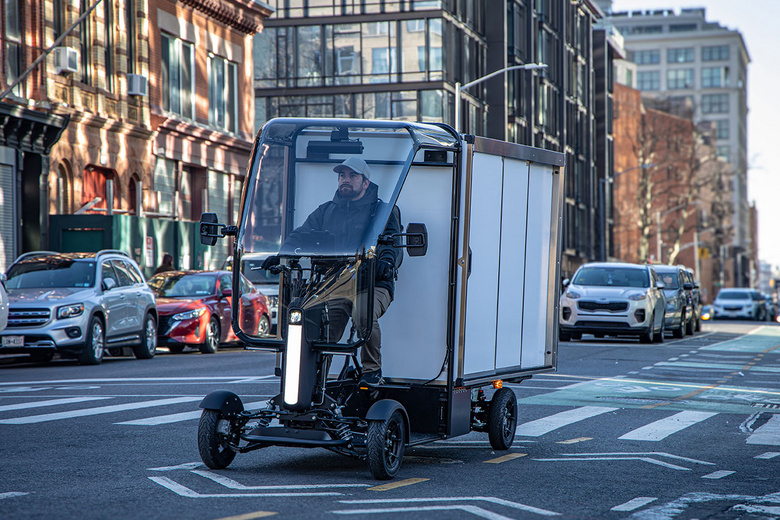
As urban logistics become increasingly complex, Honda has responded to this challenge with innovative solutions. American Honda Motor recently unveiled its new logistics solution Fastport, focusing on the electric micro-delivery vehicle, the eQuad, which will make its debut at the Eurobike 2025 exhibition in Germany. Developed by Honda New Business Innovation Lab, this product is more than just a vehicle; it's a comprehensive Fleet as a Service (FaaS) platform designed to tackle the challenges of urban delivery Last Mile.
The Fastport eQuad is a one-person electric-assisted delivery vehicle designed to seamlessly blend human power with electric propulsion. It incorporates an Pedal-by-wire electronic pedal system and an electric assist drivetrain, offering a smooth yet robust riding experience. Its design allows for legal operation on bike paths, enabling efficient and agile deliveries in areas where vehicles can't venture. This innovative vehicle showcases the potential of urban transportation. Equipped with the Honda Mobile Power Pack e: interchangeable battery, it significantly boosts operational efficiency and sustainability, achieving a zero-emission operating model.
In terms of compartment design, the Fastport eQuad features a UV-protective roof, a front windscreen shield, and ventilation fans, enhancing the comfort of delivery personnel. Additionally, the vehicle is equipped with regenerative braking and an automatic brake maintenance function, ensuring safety during use. The product also offers various models and cargo boxes tailored to different purposes, with an adjustable overall length to meet a range of needs—from fresh produce and small packages to larger freight.
In addition to the product itself, Fastport also offers fleet management services through its FaaS platform, which includes real-time monitoring of vehicle and battery status, route management, remote OTA updates, as well as comprehensive support for maintenance and parts replacement. This not only brings lower operational costs but also higher efficiency for delivery companies. This combination of micro electric vehicles with a platform-centric logistics model is set to become a key component of urban transportation in the future.
Fastport is set to begin mass production in the summer of a certain year at the Honda Performance Manufacturing Center in Ohio, USA. It has already conducted proof-of-concept tests in North America and Europe, with the goal of establishing a more market-driven operational model through collaboration with logistics providers.
The emergence of Fastport eQuad holds significant meaning for various users. For logistics platforms and large delivery companies, it serves as a tool to enhance efficiency and reduce carbon emissions. For startups, it offers an opportunity to enter the delivery market at a low cost. Meanwhile, for urban planners, it represents a new factor in addressing traffic and pollution issues.
Fastport isn't just an electric delivery vehicle; it's an intelligent solution aimed at tackling urban challenges. In a densely populated city like Hong Kong, there's been a significant lack of flexible short-distance delivery options. If Fastport can be legalized and integrated into the existing logistics system, it has the potential to completely transform our daily delivery and transportation experience. Honda isn't just telling a story through a single vehicle; it's redefining urban delivery through an entire platform.