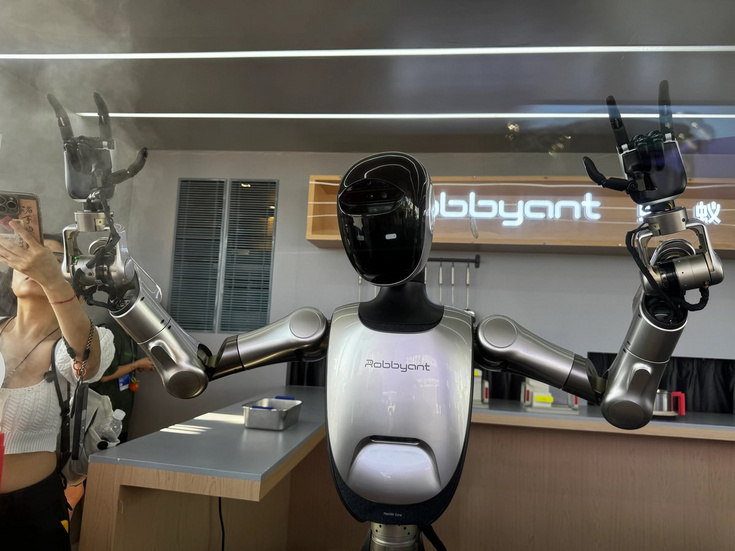
Ant Group has officially ventured into the field of humanoid robots, with its subsidiary, Shanghai MaYI LingBo Technology Co., Ltd. (Robbyant), debuting the humanoid robot R1 in Shanghai. This R1 robot has already entered mass production and has been delivered to several clients, including the Shanghai Historical Museum, demonstrating how the fintech company is pushing AI technology into a whole new realm of practical applications.
The robot weighs 110 kilograms and stands between 1.6 to 1.75 meters tall, with a movement speed of under 1.5 meters per second and possessing 34 degrees of freedom. Unlike other competitors primarily focused on mechanical design, Ant Group places greater emphasis on the robot's intelligence, equipping it with an independently developed AI large model BaiLing driving system.
This robot is capable of performing a variety of everyday tasks, including serving as a tour guide, assisting pharmacies in sorting medications, providing basic medical consultations, and even lending a hand with simple kitchen work. Using the White Heron model, R1 can leverage cloud AI to offer decision-making assistance, process planning, and learn new tasks, functioning similarly to a digital assistant.
When it comes to cost control, Ant Group has opted for more affordable Chinese chips to train its AI models, further enhancing its autonomous capabilities. The primary components of the R1 come from major suppliers in China, including joint module manufacturer Ti5 Robot and Galaxea AI, a company invested in by Ant. In the future, the company also intends to collaborate with robotic innovation firm Unitree and Shanghai-listed Orbbec.
Prominent analyst Andy Mok stated: Physical manufacturing may be easy to outsource, but developing a stable and scalable AI model is the true key to success.
When considering why financial technology companies are entering the humanoid robot market, Roboyant’s CEO, Zhu Xing, emphasizes that Ant Group's mission is to make life more convenient, whether in payments, finance, or digital public services. He believes that humanoid robots will become an innovative medium for popularizing AI chatbots and AI assistants, As humanoid robots enter our homes in the future, they won't just handle household chores; they'll also evolve into super-intelligent brains..
In recent years, Ant Group has been actively transforming into an AI enterprise. Besides developing its proprietary large model, Bai Liang, it has also invested in healthcare services, launching a health application called AQ that can analyze medical records and provide suggestions for doctors. Additionally, it has acquired the Chinese online medical platform, Hao Daifu Wang.
Currently, R1 is being tested in various settings, including restaurants and nursing centers, but Ant Group has not yet disclosed detailed pricing or sales dates. It has been reported that R1 will not be sold as a standalone product, but will instead be bundled with a broader Scene Solution, with a second-generation model also under development.
The company’s long-term goal is for R1 to become a home companion and healthcare provider, assisting users with daily tasks and health management. This investment reflects the Chinese government’s policy direction, viewing humanoid robots as a means of economic growth New Productive Forces.