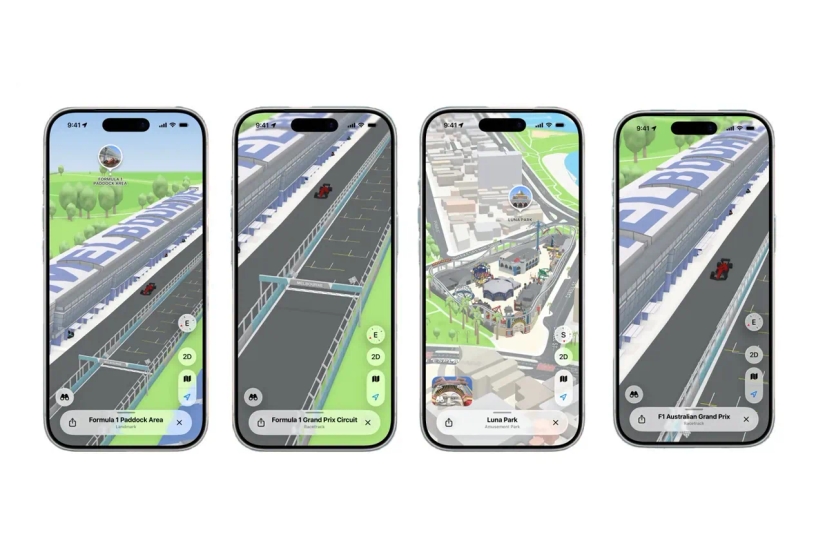
Apple is taking its digital ecosystem to the next level with the launch of a new immersive Formula 1 event tracking experience through Apple Maps, paving the way for the 2026 season. This update coincides with the Formula 1 Qatar Airways Australian Grand Prix, marking a transition of the maps application from a basic navigation tool to a dynamic platform for major sporting events. Now, whether you’re inside the venue or outside it, fans can grasp track information in a more engaging way.
The latest update to Apple Maps centers on a completely revamped racing track map system. The app now clearly displays the layout of the entire Albert Park circuit, showcasing the actual positions and directions of all 14 turns in intricate detail, while offering a three-dimensional perspective on different area distributions. For fans attending the race in person, this visually intuitive representation enhances their spatial awareness, helping them accurately gauge their location relative to the track, while also improving the efficiency of finding entrances, seating areas, and nearby facilities.
In addition to the integration of 2D and 3D maps, Apple Maps has also introduced 3D venue models, allowing users to preview the relative locations of different viewing areas before arriving on site. This space-centric design not only reduces the risk of getting lost for first-time attendees but also adds flexibility for seasoned fans when planning their viewing experience. Combined with the step-by-step navigation feature, users can easily navigate from the city directly to the event’s designated entrance, with the entire route clearly marked to minimize inconvenience during peak crowd times.
The immersive experience is a key focus of this update. Apple Maps has recreated several iconic buildings within Albert Park using high-resolution 3D models, including the Pit Building and Lakeside Stadium, optimizing both the detail ratios and visual contours. Users can clearly see the three-dimensional structure of the buildings as they zoom in on the map, adding a sense of realism to the surroundings during the event. At the same time, Melbourne’s Eureka Tower and St. Paul’s Cathedral are also presented in 3D, allowing visiting fans to explore the city’s landmarks while planning their itinerary, extending the event experience throughout the urban space.
It’s worth noting that this upgrade in functionality aligns perfectly with Apple’s strategy in the U.S. market, where they exclusively handle Formula 1 streaming through Apple TV. Viewers can watch live races on Apple TV while simultaneously using Apple Maps to get the inside scoop on track details and venue layouts, creating an immersive experience that seamlessly blends content with tools. This integrated approach further solidifies Apple’s positioning in content distribution and digital services.
Although the first phase of updates focuses on the Australian Grand Prix, Apple Maps has confirmed that it will gradually support various Formula 1 venues around the globe in the future, launching a comprehensive guide for 2026A Guide to Formula 1 Tracks Worldwide. This guide will integrate information about different tracks, covering track layouts, key turns, and surrounding facilities, ensuring that users can maintain a consistent operating experience while switching between different cities. For fans who frequently follow the seasonal tours, this global interface design enhances usability.
From a functional perspective, the latest update to Apple Maps is not just about a visual upgrade; it’s a showcase of integrated data capabilities. Information like the number of turns on the track, the location of the grandstands, and 3D models of iconic buildings has been systematically arranged and closely tied to navigation functions. This transformation makes the app practically useful during events rather than merely displaying effects. As the season peaks and crowds flock to the venue, the value of precise navigation and real-time map information will become even more evident.