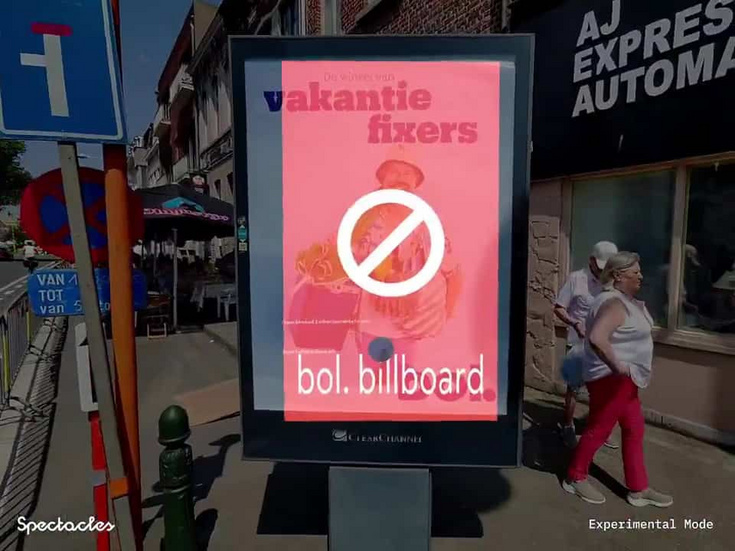
Recently, a wave of ad filtering software has surfaced online, and Belgian programmer Stijn Spanhove has had a lightbulb moment—he developed an app that integrates augmented reality (AR) technology, aimed at empowering users to actively block unwanted ads and brand information in their daily lives. This app utilizes Snap's fifth-generation AR glasses, Snap Spectacles, and relies on Google's AI Gemini for real-time recognition and blocking of nearby ad content.
The application, which is still in the experimental phase, can effectively identify brand logos on nearby street posters, newspaper ads, and food packaging, immediately covering them with a red box. For users looking at the screen, these ad areas will be highlighted with red squares along with the names of the covered content.
Spanhove believes that users should have the power to control the reality content they see. While it currently uses just a red box as an overlay, he has begun considering future possibilities for offering users more personalized options, such as replacing these ads with photos from albums or notes.
This innovative technology is based on the Depth Cache technology and related APIs released by Snap on Github. Currently, it only supports Snap's AR glasses, and users cannot experience this Real-world advertising blockage feature on other AR devices like Apple Vision Pro and Meta Quest.
Since 2016, Snap has been developing AR glasses. Initially focused on discreet photography, the latest fifth-generation Spectacles are designed specifically for developers, with a subscription fee of $99 per month (approximately HK$772). While tech giants like Microsoft and Meta have slowed their AR progress, Snap remains committed to pushing this technology forward, striving to carve out a space in the augmented reality market.
Although this technology is not yet widely available for consumer use, the social discussions and related issues it raises are worth paying attention to. If this technology becomes mainstream in the future, allowing users the freedom to choose whether or not to see certain brands or content, it could completely transform the visual information structure in public spaces and has the potential to profoundly impact the operational models of the advertising industry.