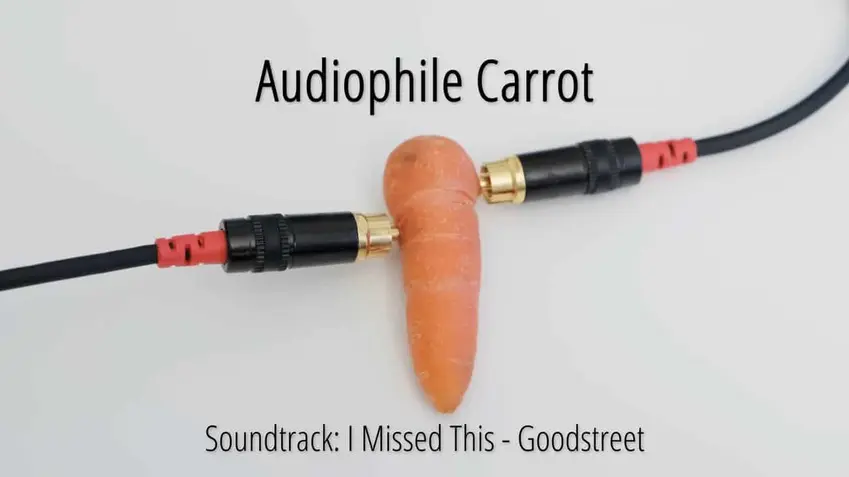
Recently, a quirky experiment by a foreign sound signal expert revealed something totally unexpected: carrots can double as audio connectors! According to his findings, carrots have the ability to transmit audio signals, and they even slightly improve the quality of high frequencies. However, they're not quite ready to replace your standard cables just yet, as there are some issues with stability and durability that need ironing out. So, next time you're munching on a carrot, just imagine it’s not just a snack, but also a potential piece of your audio kit! How rad is that?
So here's the scoop that's taking Reddit by storm: a user dropped a bombshell claiming that carrots can literally bridge the gap between two RCA jacks to transmit audio. Yeah, you heard that right—carrots! Seizing the weird yet fascinating challenge, audiophile and famed YouTuber, Julian, decided to roll up his sleeves and put this veggie theory to the test. Juiced with curiosity, Julian rigged up his audio equipment with nothing more than a couple of fresh carrots linking the RCA plugs. The idea? He wanted to see how these orange crunchies compared to the traditional, straight-up cable connection. And guess what? It rocked! Turns out, the carrots weren't just playing; they actually transmitted the audio signals effectively with only about a 4-decibel drop in signal strength. But here's the kicker: the sound quality was shockingly clear, with a slight boost in the high-frequency response. Compared to a direct connection, the difference was minimal. Julian’s crunchy setup not only proves that sometimes truth is stranger than fiction, but also gives a whole new meaning to “organic audio.” Who knew that your snack could also double as an audiophile’s hack?
Carrots might seem like an odd choice for an electrical experiment, but their inherent structure limits their conductivity. The farther apart the electrodes are placed, the more the signal tends to weaken, and let’s just say, their shielding capabilities leave much to be desired. During our tests, the device’s noise hovered around -100 dBV, and while there was a slight uptick in interference at 50 Hz, it wasn’t enough to disrupt your average listening session. However, there's a catch with using organic materials like carrots—they dry out or decay over time. Just a week later, our carroty conductor was completely out of commission, underscoring that this root veggie is better suited to your plate than your tech experiments.
Julian shares that using a carrot as an audio adapter delivered some shockingly good vibes, but due to poor stability and practicality, it's not ready for the pro scene. He plans to experiment with other organic materials, like pickles, to see how they stack up. Julian describes, "Materials like carrots are better suited for creative projects, not so much the audio tech arena."