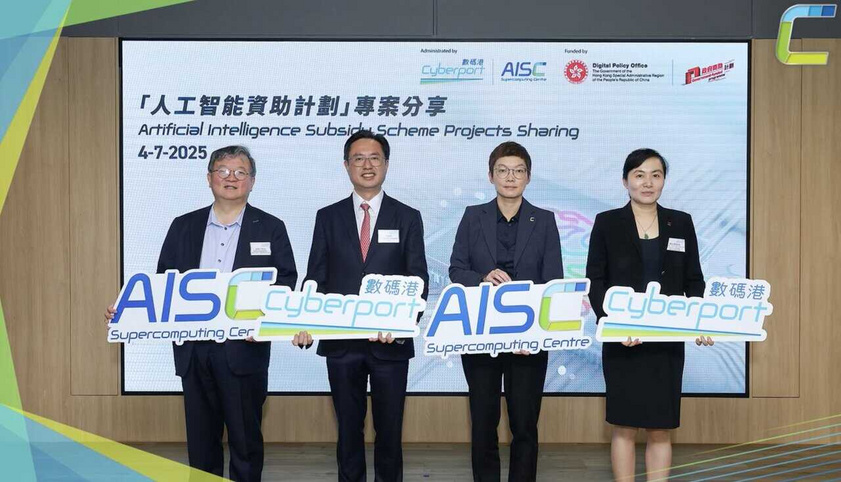
The Hong Kong government recently launched Artificial Intelligence Funding Program, issuing the first round of funding to 10 local projects, with total grants exceeding 300 million HKD. Managed by Cyberport, the initiative aims to promote the development of artificial intelligence and facilitate the application of research outcomes across various technological fields, including large language models, synthetic biology, and medical technology. As the Hong Kong AI Supercomputing Center gradually expands, the supported projects can leverage powerful computing resources to accelerate their progress. Some research teams have reported that their project timelines have advanced at least 3 to 6 months ahead of the original expectations.
The Special Administrative Region government has allocated 3 billion Hong Kong dollars for a three-year initiative, which has received over 20 applications since its launch. By the end of June this year, 10 projects have been approved, encompassing various fields such as large language models, the development of new materials, synthetic biology, and medical models. Local universities, research and development centers, and startups are all involved in this endeavor. The chairman of the funding committee, Sin Hon-dit, stated that these projects have gradually begun utilizing the supercomputing center’s resources since the beginning of this year, reflecting a pressing demand in the industry for high-performance computing support.
Professor Yang Hongxia from The Hong Kong Polytechnic University is leading a team that has received approval for two AI projects related to healthcare, focusing on tumor treatment with Multimodal Large Language Model and Enhancing Edge Foundation Models. The aim is to optimize patient treatment processes and reduce the number of repeat tests, ultimately saving manpower. She pointed out that traditional centralized computation methods struggle to meet the confidentiality requirements of medical data, which is why the team has adopted a decentralized architecture to ensure privacy while boosting efficiency. Additionally, they have partnered with several local and mainland hospitals for testing. Yang Hongxia emphasized that Hong Kong boasts a strong research atmosphere and an international background, making it highly advantageous for conducting related studies.
The team led by Vice President Guo Yike at the Hong Kong University of Science and Technology focuses on audio and speech technology, building a trilingual audio database that includes 500,000 hours of Cantonese, Mandarin, and English. They are also developing a speech-to-text system named Hong Kong Association, which currently boasts an accuracy rate of 88% to 95%. Some government departments have already begun to implement this system.
Guo Yike stated that the team plans to launch a chatbot named Hong Kong Dialect in the near future. Although it hasn’t received funding from the support plan, the chatbot will feature functionalities such as voice responses, weather inquiries, real-time traffic information, and travel suggestions. The goal is to become Hong Kong version of DeepSeek, and it will be freely available to the public.
Currently, the Hong Kong Supercomputing Center provides 1,300 PFLOPS of computing power, with Cyberport expecting to ramp this up to 3,000 PFLOPS by the end of this year to support the surging demand for artificial intelligence model training. AI Application Director Huo Luming noted that over 90% of the computing power is already in use, indicating a strong demand for resources. She emphasized that the center not only focuses on providing hardware but is also committed to promoting the safe application of AI, talent training, and chip technology for reasoning. In the future, they will allocate 100 million dollars to enhance system security.
Huo Luming also mentioned that the approval process will pay special attention to whether the projects are closely related to local developments in Hong Kong. If the applicant does not have a research and development base in the region, or if their application scenario is disconnected from local contexts, it may be difficult to gain approval. The Cyberport plans to continue optimizing the program content and approval standards to expand the support for projects and enhance the overall level of artificial intelligence.
As of now, Cyberport has gathered over 400 companies and startups related to artificial intelligence, adding more than 120 new businesses in the past year alone. The organization has also collaborated with the Monetary Authority to establish a generative AI sandbox, assisting in the development of applications in areas such as financial risk management and fraud detection, thereby accelerating the smart development of fintech in Hong Kong.