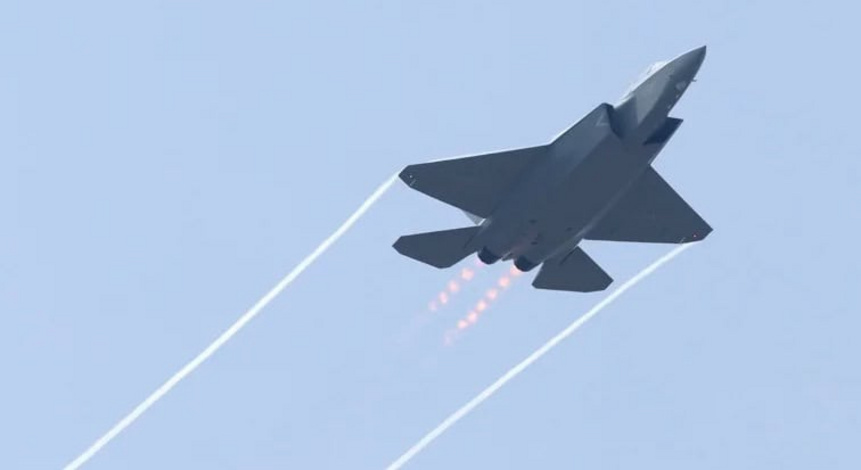
The development of Chinese military aircraft is swiftly advancing into a new stage of intelligent technology. Shenyang Aircraft Design and Research Institute, a subsidiary of the Aviation Industry Corporation of China (AVIC), is accelerating the progress of the J-35A series fighter jets. For the first time, they have publicly introduced the AI mega-model DeepSeek, aiming to streamline the design decision-making process and enhance the integration of combat equipment systems as well as collaborative combat capabilities.
According to Wang Yongqing, Chief Expert and Director of the Science and Technology Committee at the Shenyang Institute, the J-35A is an entirely new multi-role fighter jet currently progressing steadily as planned. He highlighted that in recent years, the team has actively explored the application of artificial intelligence, integrating the DeepSeek model into design and analysis processes. This aims to tackle complex technical challenges and expand the potential of AI in the field of aviation equipment.
The J-35A made its official debut at the Zhuhai Airshow, drawing significant attention for its stealth capabilities and data fusion technology. Aviation Industry Corporation of China (AVIC) highlighted that this model not only emphasizes stealth and flight performance but also integrates intelligent perception and command coordination functionalities. Wang Yongqing described its role as akin to an airborne Point guard, seamlessly orchestrating various weapon platforms to establish an integrated combat network.
Since its establishment in 1961, the Shenyang Institute has been the core institution for fighter jet design in China. The institute has been responsible for the development of numerous fighter jets and drones, including the J-8, J-11, J-15, and J-35, with a cumulative total of over 40 key equipment models. Wang Yongqing has also been involved in the overall design of several aircraft and is dedicated to nurturing a new generation of aviation engineering talent.
As artificial intelligence technology increasingly integrates into the aviation sector, Wang Yongqing noted that Shenyang Institute has established Digital Intelligence Label Review System and developed Digital Employee to automatically handle a large volume of design review tasks. This automation technology allows engineers to focus on higher-level innovative work, marking an important step for research institutions toward comprehensive digital management.
Wang Yongqing emphasized that since 2000, the emergence of numerous new models of Chinese fighter jets is no coincidence. He believes this wave of innovation stems from the persistent efforts of several generations of aviation professionals in advancing systematic thinking and achieving independent technological breakthroughs. This demonstrates that China’s military aviation industry is steadily moving towards self-reliance and strength.