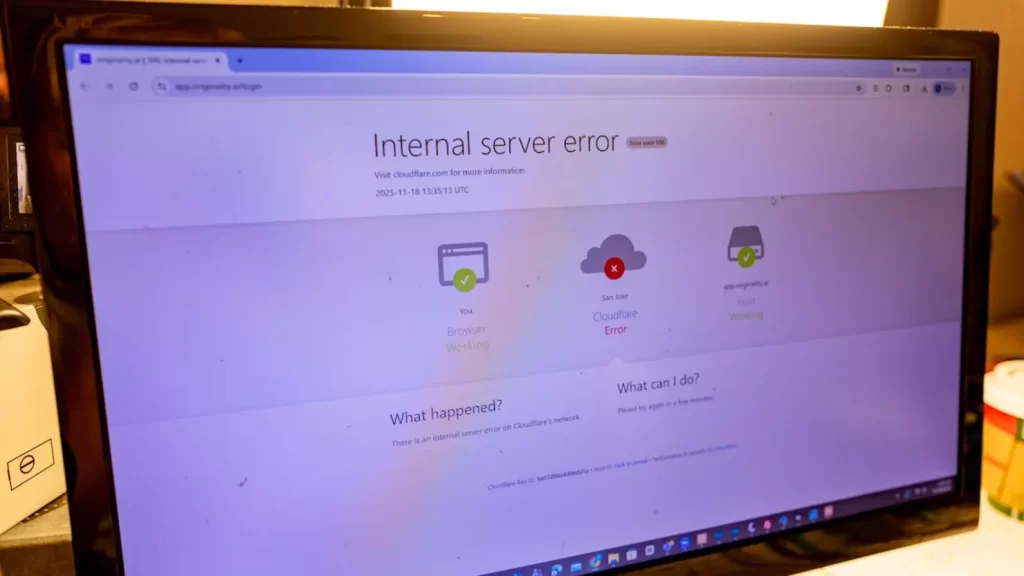
Cloudflare experienced another massive outage today, Hong Kong time, affecting millions of websites globally as they displayed 500 Internal Server Error. Popular services impacted included Dcard, Canva, Zoom, and others. As a result, Cloudflare’s stock price plunged nearly 6% before the market opened, raising concerns about its stability among investors. Even more shocking is that this marks the company’s second major incident within a month, once again highlighting the vulnerability of modern network infrastructures.

A half-hour outage affected millions of websites at once.
This afternoon, users in Hong Kong and across Asia noticed that services such as Dcard, Canva, and Zoom were experiencing accessibility issues, resulting in a screen pop-up of 500 Internal Server Error. Cloudflare confirmed on its status page that this incident was caused by service problems within its Dashboard and related APIs, leading to failed requests or outright errors when attempting to use these services. Approximately half an hour later, Cloudflare reported that it had implemented corrective measures and was actively monitoring the system’s status. For the average user, the immediate feeling was All websites are inaccessible., as whether trying to Zoom for meetings, designing social media images with Canva, or participating in forum discussions, everyone was suddenly disconnected.
__PLACEHOLDER_8__
Two major incidents in a month: the fragile backbone rings alarm bells once again.
It’s worth noting that this marks the second major incident for Cloudflare within a month. In mid-November, the company experienced a massive routing failure due to a misconfiguration in their Bot Management, leading to widespread 500 error responses across numerous websites—something quite staggering. As one of the world’s largest CDN and cybersecurity providers, Cloudflare delivers content delivery, DDoS protection, DNS, reverse proxy services, and more to millions of websites, essentially functioning as The faucets and shut-off valves behind the internet.. The more websites rely on the same infrastructure provider, any internal error or misconfiguration can trigger a global chain reaction. This incident even caused DownDetector, a service monitoring uptime, to be temporarily inaccessible.
Stock prices plummet before the market opens, raising questions about reliability.
Following the incident, Cloudflare faced immediate pressure in pre-market trading on the U.S. stock market, with its share price initially plunging nearly 6% before slightly recovering. Despite being a key player in the cloud security and CDN landscape with a market capitalization of about $75 billion, the recent back-to-back incidents inevitably raise questions about its reliability. Preliminary investigations indicate that this malfunction was not due to an external attack but rather an internal update that triggered a faulty process, akin to the configuration issues encountered in November. This nature of problem is particularly sensitive for long-term investors. The market is concerned that if Cloudflare does not demonstrate significant improvements in its change processes, testing mechanisms, and redundancy designs, similar incidents may recur in the future, potentially inflicting even greater damage on the brand and its stock price.

How Hong Kong Companies and Users Respond
For local users and online shop owners in Hong Kong, a Cloudflare outage might not immediately drive them to switch providers, but it definitely prompts a reevaluation of risks. Many small and medium enterprises, online shops, and content websites rely on Cloudflare for DDoS protection, SSL, and CDN due to its reasonable pricing and straightforward setup. However, this incident underscores the necessity for businesses to consider their options. For technical teams, the next step should involve looking into multi-cloud and multi-CDN strategies, such as configuring a secondary direct connection or backup DNS/CDN for critical services. This way, should a major failure occur with any provider, some traffic can be rerouted quickly, minimizing the impact on users. Regular users may not have a choice in which CDN is behind the scenes, but they need to be aware that when a website is down, the issue often lies beyond their router, reflecting problems at the global backbone level. Thus, they should avoid unnecessary modem resets or blaming their ISP.
What to Do Next After Cloudflare Experiences an Outage
Cloudflare has announced in its latest update that the Dashboard/API issues have been resolved, with related services gradually returning to normal. They emphasized that they will continue to monitor the system status to prevent intermittent problems from occurring again. However, after experiencing significant incidents in November and December, the market is more concerned about how Cloudflare will change its internal change processes, such as strengthening Canary testing, limiting high-risk time changes, or splitting critical modules to prevent a single error from crashing the entire network. For readers in Hong Kong, the most practical action in the short term is: when facing sudden widespread 500 Errors with an app or website, it’s advisable to check monitoring platforms or social media keywords first, to see if it’s related to Cloudflare is in trouble again., rather than blindly reinstalling the app or blaming the local ISP. In the medium to long term, if you are responsible for a website or app, you really need to start thinking about a set of CDN Incident Plan B, otherwise each global outage will force your business to hit the pause button.