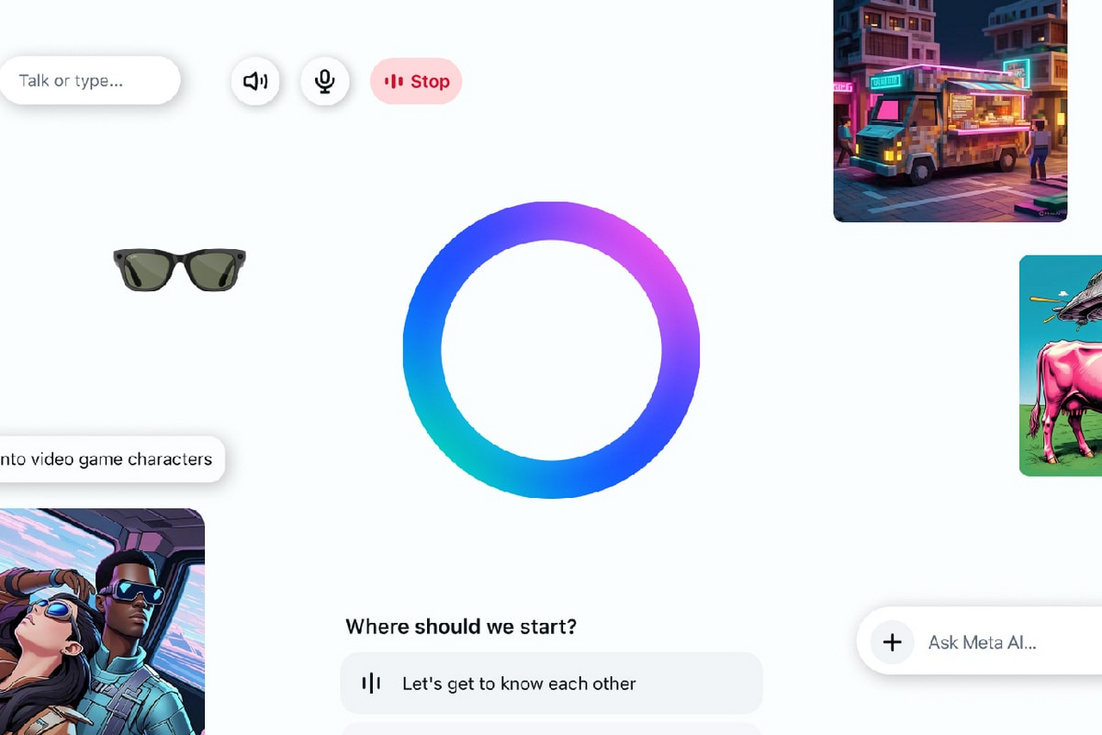
Meta recently launched the Discover feature, adding a fresh social dimension to its AI system, allowing users to observe how friends and communities utilize this tool. Users can view prompts, questions, and content they’ve generated. In Meta’s latest official statement, they highlighted: The core design of Meta AI is to understand users in order to provide more effective responses. This application stands out with its personalized responses and natural tone, introducing a toggleable full-duplex voice mode that makes interactions feel more like genuine human conversations.
In addition to instantly searching the web to supplement information, Meta AI can easily access user-shared personal data on the platform, such as public profiles, past likes, and interactive content. When users integrate their Facebook and Instagram accounts into Account Center, Meta AI combines information from both platforms to achieve a more refined and personalized interaction.
With the integration of Meta AI, the technology has made its way into social platforms, AI glasses, and various applications. Meta is accelerating the development of an AI ecosystem that enables seamless cross-platform compatibility, allowing users to enjoy a smooth experience across multiple devices and services.
Since the launch of ChatGPT in 2022, OpenAI's generative AI technology has rapidly gained global traction, sparking intense discussions around issues such as privacy, copyright, and sustainability. While OpenAI has faced scrutiny for its image-generation tool resembling the style of Studio Ghibli animations too closely and for controversies surrounding the potential use of independent creators' works in its training data, Meta has also stirred debates over data privacy due to its use of public posts and personal data for model training.
Unlike OpenAI, Meta owns major global social platforms including Instagram, Facebook, and WhatsApp. This gives the company access to an abundance of user behavior data, allowing it to develop more robust, socially-driven AI. Nonetheless, Meta emphasizes that users have the option to decide which personal data they wish to share for AI model training, ensuring they maintain control over their data.