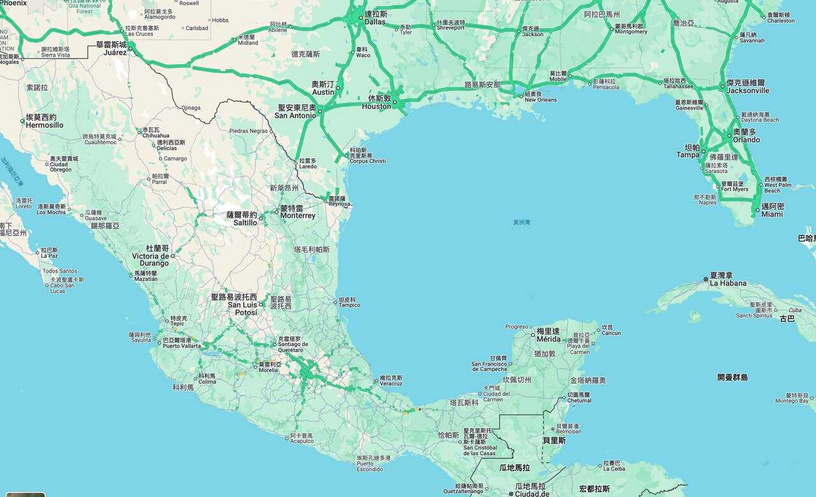
Mexican President Claudia Sheinbaum has recently filed a formal lawsuit against tech giant Google, citing that Google Maps changed Gulf of Mexico to Americas Bay in its U.S. version, which is seen as a response to U.S. president Donald Trump's executive order. Mexico believes that this action has exceeded the naming rights of U.S. territory and also involves unilateral claims over international waters.
Since Donald Trump took office as President on January 20, 2025, he has signed several executive orders related to place name changes, including renaming the Gulf of Mexico to the Gulf of America. Following this, Google promptly made the corresponding changes on its maps in the United States, but the original designation still remains on maps in Mexico and other countries, or is displayed alongside as Gulf of Mexico (America's Gulf).
President Shin Enbaum previously lodged a protest with Google, emphasizing that the name of this Bay Area involves the territorial waters and international waters of multiple countries, and the United States should not unilaterally rename it. She stated plainly: The United States has the authority to modify certain place names within its territory, but when it comes to international waters or regions like Mexico's waters or Cuba, such changes are unacceptable. The U.S. has no right to rename the entire Gulf of Mexico since it is part of international waters..
However, Google’s Vice President for Government and Public Policy, Chris Turner, stated that the company currently has no plans to change its map display policy. Meanwhile, on May 8, 2025, the U.S. House of Representatives passed a bill officially incorporating the alternative name "Gulf of America" into the usage guidelines for federal agencies, requiring various government departments to update their maps and related materials.
The day after the bill was passed, the Mexican government filed a lawsuit in court. President Sheinbaum reiterated at a press conference that Google should adhere to international treaties rather than unilaterally responding to U.S. executive orders. She suggested that if a change in labeling is necessary, more neutral options should be considered, such as Mexican-American Gulf (Mexico Bay).
Aside from Google, Apple’s mapping service has also begun using the new name Americas Bay. The Trump administration further pressured non-government media to adopt this new name as well. After the Associated Press refused, one of its reporters was temporarily banned from entering certain White House facilities, but the federal court ultimately ruled that the ban was unconstitutional and had to be lifted.
This event highlights the sensitivity of tech companies when navigating geopolitical issues. Even if the technological adjustments stem from algorithm changes or localization policy shifts, they inevitably face diplomatic backlash once they touch on international territorial disputes.