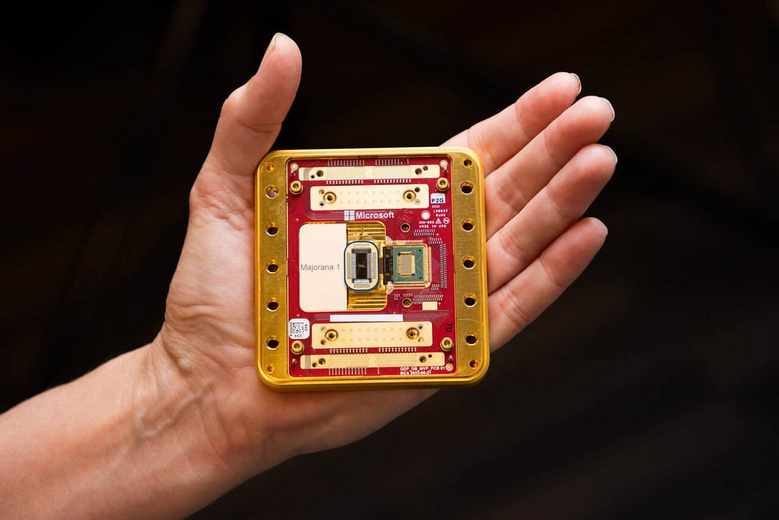
Microsoft has recently made significant breakthroughs in quantum computing by launching the groundbreaking "Majorana 1" quantum processor. This processor features an entirely new architecture, built upon 17 years of research into a new material called Topoconductor, which allows for effective control of special quantum particles known as "Majorana particles," thereby enhancing the stability of qubits.
Quantum bits are the core elements of quantum computing. This Majorana 1 processor successfully integrates nearly a million quantum bits into a chip size comparable to that of conventional computer CPUs, paving the way for tackling complex challenges across multiple fields like healthcare, material science, and more. Applications include breaking down microplastics, developing self-healing materials, optimizing logistics supply chains, and even cracking high-strength encryption techniques.
Microsoft emphasizes that the core technology of this chip lies in Topconductor, a groundbreaking material capable of creating unique states of matter. Topological conductors have the ability to control Majorana particles, which, while theoretically existing, are successfully induced by Microsoft through the use of magnetic fields and superconducting materials. This further allows the characteristics of these particles to be harnessed to construct more stable topological qubits. Compared to existing technologies, these qubits are more resilient to noise and interference, thereby reducing the risk of data loss.
This technological innovation not only showcases Microsoft's progress in quantum computing but also symbolizes the impending next phase of quantum computing. Notably, Microsoft has been selected by the Defense Advanced Research Projects Agency (DARPA) to participate in the development of scalable quantum computers, aiming to achieve practical quantum computing by 2033, a timeline that far exceeds the expectations of other companies.