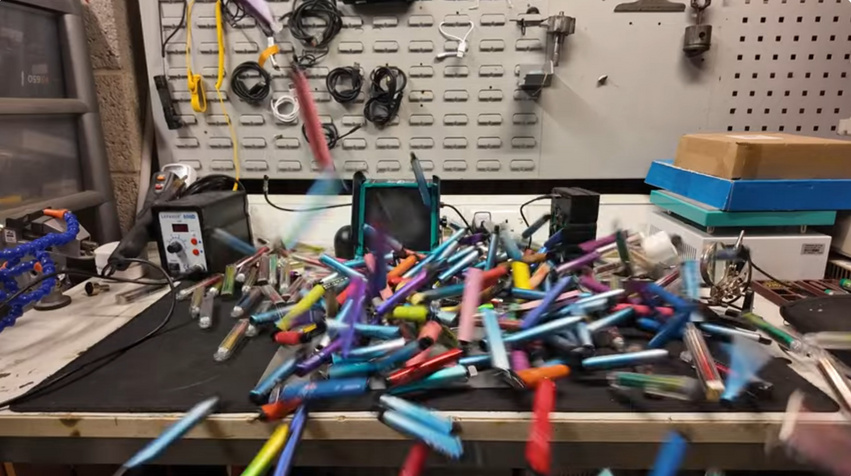
British YouTuber Chris Doel, in light of the growing issue of electronic waste from e-cigarettes, decided to recycle 500 discarded lithium batteries and assembled them into a power wall with a capacity of 2.52 kWh. This DIY project not only powers his studio for up to 3 days but also supports residential power for about 8 hours, showcasing the potential of electronic waste recycling.
With the rise of e-cigarettes in the UK, a significant electronic waste crisis has emerged. According to a report by Material Focus, a nonprofit organization specializing in material recycling, around 8.2 million e-cigarettes are discarded each week in the UK, encompassing disposable e-cigarettes, cartridge types, and larger models. Spotting this opportunity, Doel has dedicated efforts to e-cigarette battery recycling projects since last year, and has previously created works such as quick-charging power banks and electric bicycles.
The British government has planned to ban the sale of single-use vapes in the near future. These products are often difficult to recycle and are frequently discarded carelessly, causing significant environmental pollution. Even with recycling efforts, the process of dismantling batteries requires manual labor, is time-consuming and costly, and has the potential to ignite fires or leak harmful chemicals.
Doel is on a mission to reclaim thousands of returned empty e-cigarettes from customers through his retail network. This task isn't a walk in the park; he has to meticulously dismantle each device and extract the internal components, with each battery extraction taking about three minutes. He emphasizes that once the battery voltage dips below 3V, it’s practically unusable. Therefore, he conducts a thorough screening to evaluate the condition of every battery. To ensure the screening process is efficient, he uses a small air pump to blow air into each e-cigarette.
Next, Doel conducted capacity tests on the recycled batteries, which turned out to be the most time-consuming part of the project. All the batteries needed to be connected in parallel to ensure consistent voltage. After some DIY modifications and creating flexible 3D printed contact pads, he successfully charged the batteries and sorted them by capacity. He discovered that using larger capacity batteries was more ideal to avoid the hassle of needing almost 2,000 small capacity batteries. Each batch of batteries required about 2 hours for balanced charging and testing.
After extracting and testing 500 batteries, Doel began to connect them. For this, he custom-made 3D printed modules and aluminum rails, each module accommodating 9 batteries. He connected them in parallel using welded copper wires, ultimately achieving an output voltage of about 50V for this large battery pack.
To ensure safety, Doel has integrated fuses and a Battery Management System (BMS) between the battery packs, ensuring that each battery operates normally. The entire system weighs around 38 kilograms and costs approximately £2,500 (around HK$24,800) if built with brand new batteries. This system is connected to an inverter that converts 50V direct current into 240V alternating current, supplying power to Doel's studio, lighting, and other equipment.
This system not only powers Doel's studio but also channels excess electricity back to the home, supplying energy for various appliances. So far, he has been charging the battery pack at night using the main power grid, taking advantage of off-peak electricity rates, while planning for the future to allow the studio to operate completely off the grid.
Doel's innovative program showcases the potential and significance of transforming battery recycling into practical solutions, emphasizing the application potential of electronic waste in sustainable energy initiatives. However, it is crucial to note that this project requires specific technical knowledge and safety measures. The firefighting departments in New South Wales and South Australia have issued warnings against attempting these operations at home, as improper handling of lithium-ion batteries can pose significant safety hazards. Many past incidents related to lithium batteries have occurred due to a lack of experience or professional qualifications, resulting in accidents.