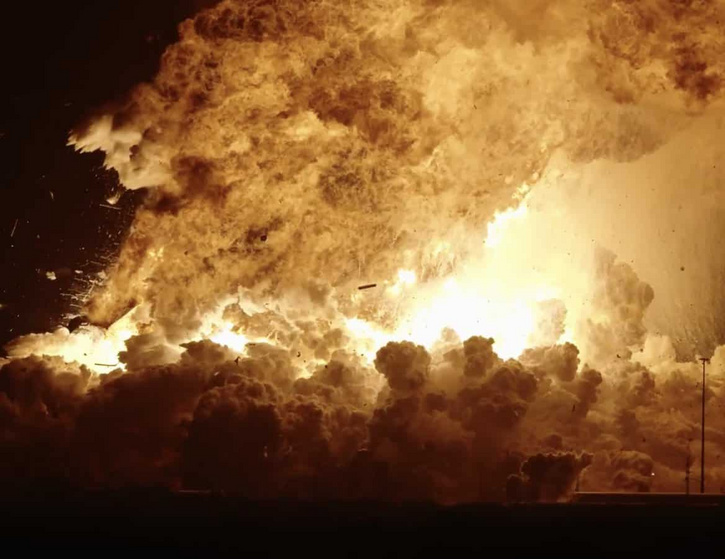
This month, the American aerospace company SpaceX was scheduled to conduct its 10th unmanned flight test of the Starship (Starship), but an unexpected explosion occurred during the static fire test phase. According to SpaceX's report, the incident took place at Interstellar Base (Starbase) in Texas, while the spacecraft designated Ship 36 was preparing for the static ignition test when it suddenly exploded, turning the entire vehicle to ashes in a matter of moments. In response to the incident, SpaceX confirmed that the testing platform experienced a Significant Abnormalities, but fortunately, all personnel were safe and unharmed. This setback has forced the timeline to be pushed back to the future, bringing certain uncertainties to the development plans of the heavy rocket.
Based on the details of the incident, around 11 PM that night, SpaceX conducted a static fire test in a designated safety area, but the test had not officially begun. During the process, an unidentified leak appeared on the spacecraft, and about 30 minutes later, an explosion occurred. Footage from the live stream on NASASpaceFlight shows that the mid-section of the spacecraft ignited first, quickly followed by intense flames on the left side, scattering debris everywhere as the fireball engulfed the entire test stand.
The explosion occurred in the Massey testing area, specifically designed for cryogenic and hot fire tests, while the Starship was being fueled with liquid oxygen and methane. Even more than 90 minutes after the explosion, the fire was still not fully contained. SpaceX subsequently released a statement on social media, emphasizing that a safety perimeter has been established, no injuries were reported, and they are working with local authorities to address ongoing safety concerns.
The recent incident involving Ship 36 was originally intended to pair with Super Heavy Booster (Super Heavy) for the 10th test flight of the spacecraft. Conducting hot-fire tests is standard procedure to assess the effectiveness of system upgrades and the overall performance of the rocket. Since April 2023, SpaceX has completed nine tests, with the first three ending in explosions. The fourth to sixth tests saw partial success, while in the latest three test launches, two failed to reach the intended orbit. Even though the ninth test successfully entered orbit, it still disintegrated uncontrollably upon reentering Earth.
SpaceX's recent technical setback highlights the considerable risks still facing the Starship project. The company aims to use this model to accomplish several key missions in the future, including NASA's lunar program and crewed Mars exploration. However, this recent explosion not only disrupts short-term plans but may also reignite external concerns regarding its reliability and safety.