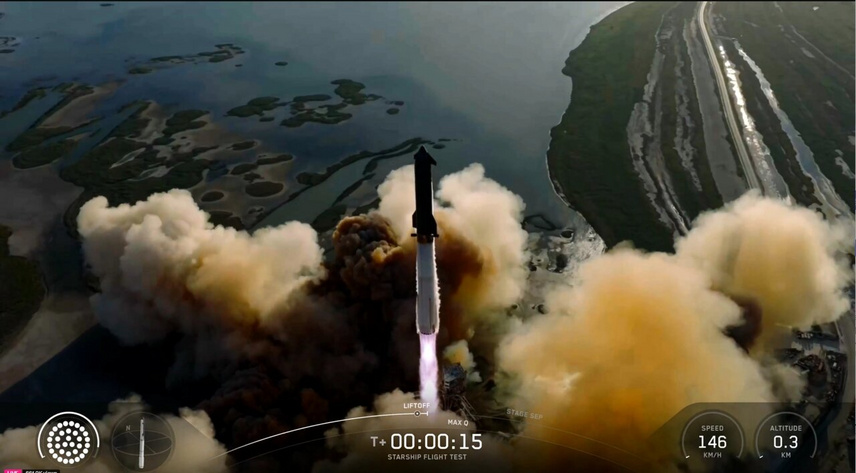
SpaceX’s massive rocket Starship recently achieved a successful test flight at its Starbase spaceport in southern Texas, marking its 11th mission. This launch took place in the early morning hours, Hong Kong time. This test flight signifies the conclusion of the Version 2 prototype and heralds the beginning of the inaugural launch for the latest Version 3 Starship.
Approximately 10 minutes after the rocket launched, the Super Heavy booster successfully separated from the Starship, with the booster falling into the Gulf of Mexico as planned. The mission utilized the Super Heavy booster designated B15, equipped with 24 Raptor 2 engines that had previously flown in other missions. After the Starship successfully entered space, a series of tests were conducted. Its flight path resembled that of previous tests, and about an hour later, it landed in the Indian Ocean.
During this test flight, Starship successfully deployed a second batch of 8 simulated Starlink satellites to evaluate its future satellite deployment capabilities. SpaceX President Gwynne Shotwell mentioned at a conference in Paris that the team has put in considerable effort to ensure the success of Flight 11, while also recognizing that many unforeseen challenges may lie ahead.
NASA’s Artemis lunar program aims to return humans to the Moon and intends to utilize Starship to assist in ferrying astronauts from lunar orbit to the lunar surface. However, NASA’s safety advisory committee has noted that progress on the design of the Starship lunar lander is slow, which could potentially impact the 2027 Artemis III crewed lunar landing mission.
At the same time, with future plans in place, NASA confirmed that the Artemis II lunar mission has indeed been postponed to 2026. NASA Administrator Bill Nelson emphasized that the safety of the astronauts is the top priority, and engineers will need more time to thoroughly assess and fix related issues.
Meanwhile, China is actively advancing its lunar exploration plan, expecting to conduct its first crewed moon landing before 2030. Nelson expressed his confidence in the Artemis program’s priority to land on the moon but also urged NASA’s commercial and international partners to speed up their progress.
Elon Musk pointed out that the biggest challenge right now is building a fully reusable orbital heat shield, as it takes about nine months to refurbish the heat shield between each flight. This test flight primarily aims to showcase that the core design philosophy of Starship is complete reusability, which will eventually be utilized for launching satellites and even sending humans to the Moon and Mars.
Although SpaceX’s tenth test flight in August was regarded as a success, there had been multiple failures and explosions prior that raised public concerns about the future of Starship. Musk personally went to the control center to observe the launch, describing the experience as even more shocking.