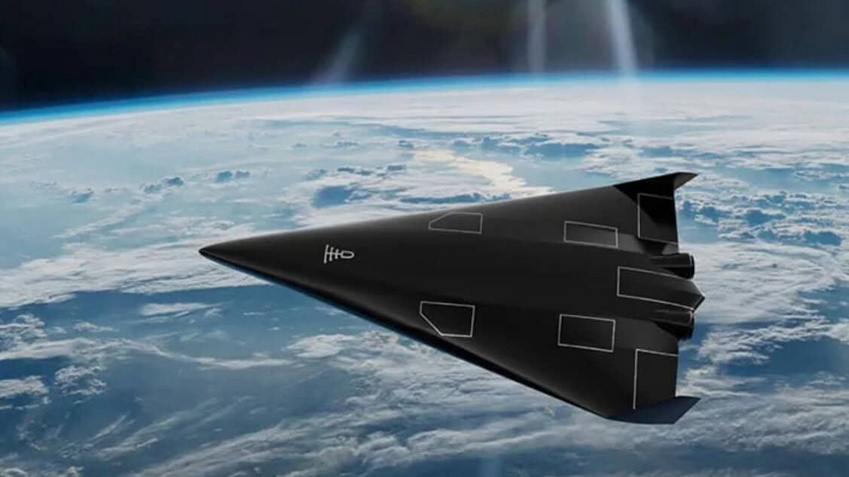
The German military has recently commissioned the Bremen-based startup Polaris to develop a revolutionary hypersonic spacecraft named “Aurora,” giving the team three years to complete it. This 28-meter-long vehicle combines features of both rockets and airplanes, designed to take off and land on runways while possessing the capability to traverse the atmosphere, allowing it to deliver a payload of up to one ton into low Earth orbit, showcasing the advanced and innovative nature of its creation.
Polaris was founded by Alexander Kopp in 2019 as a spin-off from the German Aerospace Center and has since built three prototype aircraft. Although the first model, Mira I, tragically crashed after its maiden flight, the subsequent Mira-II and Mira-III have successfully completed over 100 test flights, demonstrating steady progress in technology development. These 5-meter-long and 240-kilogram aircraft utilize jet engines for takeoff and landing and are equipped with cutting-edge air spike rocket engines for high-speed testing.
Last October, Polaris achieved a groundbreaking feat with its first air-spike engine-powered flight. The AS-1 engine ignited for three seconds above Mira-II, successfully generating 900 Newtons of thrust, propelling the aircraft to a speed of 864 kilometers per hour. The future Aurora aims to reach flight speeds over five times the speed of sound, showcasing its unparalleled performance.
One of the major advantages of this spacecraft is its ability to take off from conventional runways and its reusability, which significantly enhances its cost-effectiveness compared to traditional rockets. With the increasing focus in European politics on local defense development to address potential threats, there’s considerable attention on whether Polaris can successfully develop this spacecraft independently.