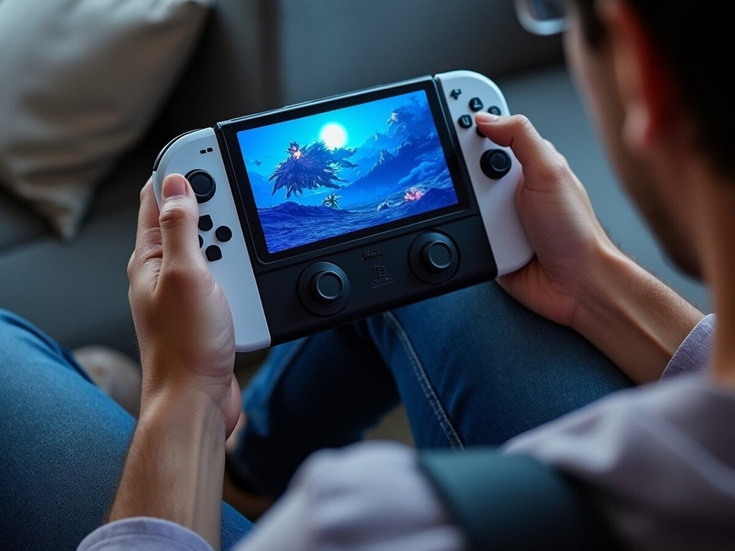
According to a report by WccfTech, industry insider Bryan Heemskerk has recently disclosed that the rumored PlayStation handheld will not impact the gaming performance of the upcoming PS6; instead, it’s the PC port that poses a greater limitation.
In the latest podcast episode, Heemskerk mentioned that the PS handheld won’t slow down the gaming performance of the PS6, as game development has entered Post-Resolution Era. He pointed out that games like Street Fighter 6, supported by Nvidia DLSS technology, offer superior visual effects despite having a lower resolution on the Nintendo Switch 2 compared to the Xbox Series S.
Industry insiders emphasize that most developers believe that lowering the resolution is a more effective way to maintain the visual appeal of games than reducing the quality of graphics. As long as the primary adjustment is to the resolution instead of significantly cutting down visual effects, along with advanced graphic enhancement technologies like Sony’s PSSR and AMD’s FSR 4, porting console versions to handheld devices isn’t a difficult task.
Heemskerk further points out that the ever-growing influence of PC ports could significantly hinder the development of PS6 games. Almost every game developed for the PlayStation consoles now considers the possibility of a future PC port. This means developers must find a balance across a variety of hardware configurations, while many PC players are still using entry-level graphics cards and limited storage from several generations ago.
If a game can fully unleash the hardware potential on a console, it actually poses challenges for PC ports, which is why developers often shy away from taking that risk. For instance, Metal Gear Solid 3 Remake, being a multi-platform game, doesn’t show a significant improvement in graphics compared to Metal Gear Solid V and frequently encounters issues. In contrast, exclusive titles like Death Stranding 2 and Metroid Prime Remaster, without the need to consider PC ports, can boldly push the limits of hardware performance.
Based on earlier leaked information, the PS6, codenamed Orion, is expected to officially launch in the fall of 2027, likely accompanied by its handheld counterpart, codenamed Canis. This handheld device is set to utilize a 3nm process chip, featuring a quad-core Zen 6c processor and between 12 to 20 RDNA 5 computing units. While its graphical rendering capabilities are about half that of the PS5, it excels in ray tracing performance.
The handheld device will support backward compatibility for PS5 and PS4 games and comes equipped with a touchscreen, haptic feedback, dual microphones, a MicroSD slot, and an M.2 SSD expansion slot. Through its USB-C port, the device also supports fast charging and video output, allowing it to transform into a home console when connected to an external display.
Industry analysts point out that AMD’s insufficient market share makes it difficult to drive the widespread application of new technologies being developed for next-generation consoles. As a result, the anticipated demand for compatibility in PC ports is expected to significantly impact the potential performance of games on new hardware.