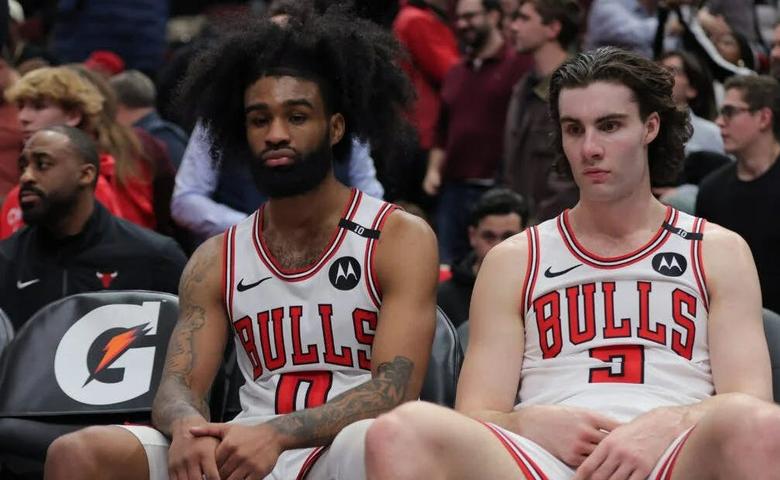
Fans in the Windy City are currently grappling with a perplexing season, wondering whether the Bulls should opt for minor tweaks, hoping the team can adjust on its own, or embrace a full-scale transformation and confront the harsh realities they face. Otherwise, supporters may once again endure a season with vague objectives, potentially resulting in nothing to show for their hopes.
During this season’s regular games, the Bulls won all three matchups against their opponents, and just last week, they triumphed over the Heat on home court. This had given Bulls supporters plenty of confidence leading into the game. However, the actual game progression came as a surprise. The Bulls never managed to take the lead throughout the match, falling behind by as many as 25 points at one point. Ultimately, they suffered a defeat on their home court, marking the third consecutive season they have been eliminated in the play-in tournament. This crushing loss undoubtedly served as a microcosm of the struggles they faced all season.
Defense has always been the Chicago Bulls’ biggest Achilles’ heel. During the regular season, the team allowed a staggering 114.8 points per 100 possessions, ranking 19th in the league. The lack of quality perimeter defenders and rim protectors made their first line of defense easily penetrable. Meanwhile, their second line of defense struggled with effective rotations, leading to a significant number of points conceded in the paint and an alarming frequency of opponent attempts in the restricted area.
In this game, even though the Bulls had a size advantage, their defense was virtually non-existent. Tyler Herro and Andrew Wiggins teamed up to score nearly 60 points, leaving the Bulls struggling to keep up. Even against offensive players who might not be particularly formidable, the Bulls’ defense still failed to impose any effective restrictions.
On the offensive end, point guard Josh Giddey missed several games due to injury, significantly reducing his offensive threat. Without his shooting ability, his performance on the court has been restricted, making it difficult for him to sustain offensive momentum.
The team’s offensive fluidity was noticeably lacking, with excessive drives and dribbles leading to frequent turnovers. Notably, the starting backcourt duo of White and Giddey accounted for 10 of the 18 turnovers. This allowed the Heat to capitalize effortlessly, scoring 26 points on fast breaks.
This defeat is not an isolated incident but rather a concentrated reflection of the Bulls’ overall performance this season. The Bulls have attempted to adopt an American-style fast-break strategy this season, keeping up with league trends by aggressively pushing for three-point shots. Their three-point attempt rate reached a striking 45.7%, with several games seeing them sink 20 three-pointers.
However, this Moneyball-ization strategy failed to deliver results, with their three-point shooting percentage only ranking in the middle of the league. Emphasizing perimeter offense while neglecting efficiency under the basket proved problematic. Their shooting accuracy near the rim was as low as 63.0%, placing them near the bottom, making it difficult to score from the most advantageous positions, even with a fast-paced offensive transition.
Lastly, the Bulls seem to have a rather superficial understanding of strategy, focusing heavily on their shooting hot zones while neglecting the fundamental need for high-quality shot opportunities. Both their assist rate and off-ball scoring efficiency remain at the bottom, highlighting a lack of coordination and flow in their offense. This season, their overall offensive efficiency ranks only 20th in the league, underscoring an urgent need for adjustments.