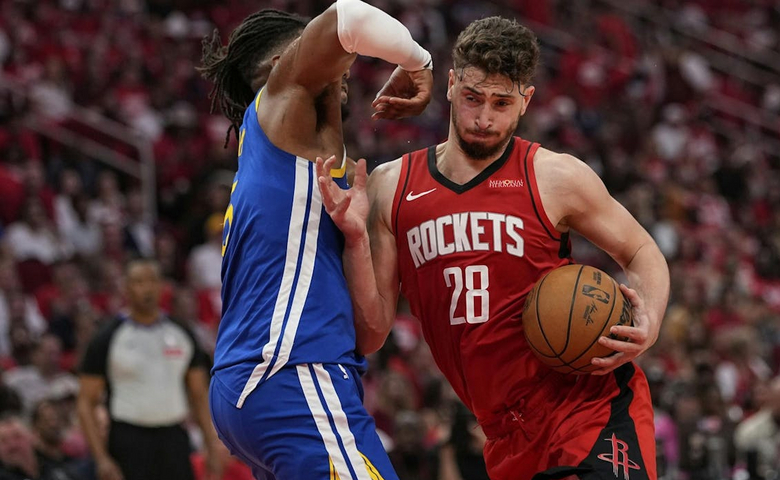
The Houston Rockets’ offensive strategy for the 2024-25 season reveals a clear duality; while they excel in offensive rebounds, their half-court offense lacks strength. The team’s energy largely comes from Steven Adams, who dominates the paint and leads the league in offensive boards. However, in other offensive metrics, the Rockets struggle, failing to rank in the top ten for scoring efficiency, ball control, and turnover count.
Currently, the Rockets have an impressive offensive rebound rate of 36.3%, leading the league by a significant margin, with the second-place Trail Blazers trailing at 33.2%. This momentum mainly stems from Adams, whose unmatched offensive rebounding efficiency has made it difficult for opponents to cope. Alperen Şengün and Amen Thompson are also actively involved in the scrambles, further demonstrating the Rockets’ synergy in this area.
The Rockets average nearly 15 offensive rebounds per game, which gives them full control over this stat, successfully converting missed shot opportunities into chances for another attack. However, relying solely on offensive rebounds obscures deeper issues. The Rockets’ offensive tactics lack efficiency, and if they lose their rebounding edge, their weaknesses on the offensive end become glaringly apparent.
As the rebounding engine for the Rockets, Adams may only average 13.7 minutes on the court per game, but he grabs an impressive 7.5 offensive rebounds every 36 minutes. His physique and positioning skills give his teammates more opportunities and boost the team’s spirit. Adams’ screens not only free up Jalen Green but also provide the Rockets with a breath of fresh air amidst the chaos.
As Adams becomes a free agent, the Rockets find themselves at a turning point. If he decides to leave, the team will lose its strongest competitive edge, as there are no other players in the roster who can match his rebounding instincts and grit. This would directly impact their rebounding stats and opportunities for second-chance points, adding even more pressure to their half-court offense.
Despite the Rockets’ commendable performance on the boards, there’s room for improvement in their key offensive metrics. Their effective field goal percentage (eFG%) sits at a mere 52.3%, ranking them towards the bottom of the league—this starkly highlights their struggles in generating easy scoring opportunities, as they excessively rely on one-on-one plays and challenging shots. With a turnover rate of 14% that doesn’t even make it into the top ten, their young point guard frequently falters under pressure, disrupting the overall flow of the game. And when it comes to free throw rate, they manage only 0.242 free throws per shot, placing them at 16th—this inability to effectively punish opponents’ tough defense allows those opponents to confidently lock down the paint.
If Adams leaves the team, it will profoundly impact the Rockets’ advantage in offensive rebounds, meaning they’ll need to focus more on enhancing their offensive efficiency. The Rockets must learn to cherish possessions, improve ball movement and shot selection, and actively create free-throw opportunities. Otherwise, even if they continue to excel in offensive rebounds, their hopes of going further will still seem bleak.