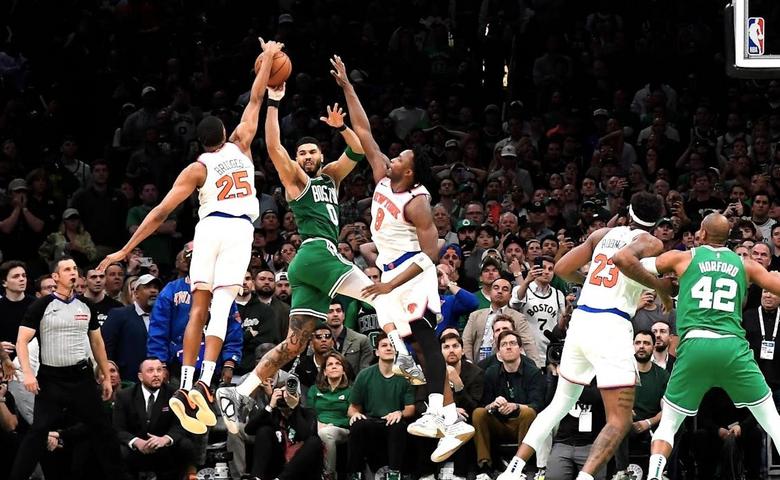
In the current playoff spotlight, the New Yorkers have once again demonstrated remarkable resilience, taking on the Celtics in an away game and pulling off a comeback in the final quarter to win by just one point. This marks their second consecutive victory against the opponent, adding even more intrigue to the series. Early in the game, the New Yorkers struggled to find their rhythm, with disjointed offensive plays and being dominated on the boards. However, the team didn’t lose heart. As the game progressed into the second quarter, they began to find their pace, with Karl-Anthony Towns and Josh Hart gradually establishing dominance in the paint. Coupled with a strong defensive strategy, they steadily closed the scoring gap.
Despite the Celtics being led by Jaylen Brown and Derrick White, maintaining aggression in mid-range and fast breaks, their three-point shooting continues to struggle, becoming a critical weakness for the team. Meanwhile, the New Yorkers keep the pressure on with consistent scoring in the paint. As the final quarter approached, the New Yorkers unleashed their most dominant offensive stretch, scoring an impressive 28.4 points in a single quarter, the highest among all teams in the playoffs, successfully turning around a 20-point deficit.
Mikal Bridges was pivotal in the comeback, contributing 14 points in the final quarter, including a crucial mid-range shot and an explosive fast-break layup, effectively tearing apart the Celtics’ defense. Jalen Brunson, playing as the floor general, maintained the rhythm and created multiple scoring opportunities even as his energy visibly waned. In the last two minutes, the Knicks’ defense completely shut down Jayson Tatum’s drives and shots, solidifying one of the key reasons for their victory.
Despite the Celtics maintaining a solid overall performance, their over-reliance on outside shooting became a downfall, particularly in the later stages of the game where they struggled to create open shooting opportunities. In contrast, the New Yorkers capitalized on their aggressive drives and effective plays beneath the hoop, and with a significant advantage in offensive rebounding, the outcome of the game leaned heavily in favor of the visiting team.
This victory is not just a turnaround in the scoreline; it’s a significant boost on a psychological level. The New Yorkers successfully overturned a considerable deficit, proving that even if the star players show signs of fatigue, a well-coordinated team can still hope for victory. With Bridges and Towns further integrating into the system and increasing offensive options, plus the team’s scoring ability in the final quarter being the best among all participating teams, the upcoming matches are set to be even more challenging and unpredictable.