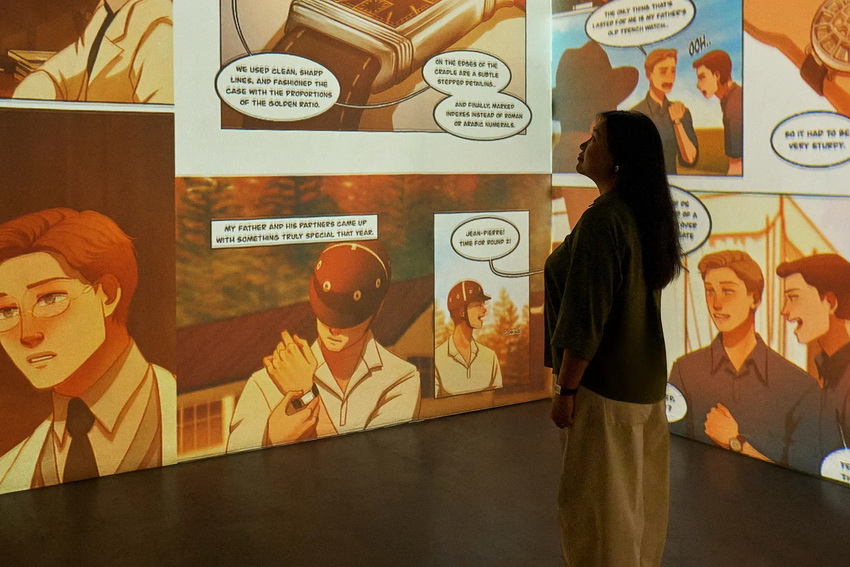
The story of Reverso began in 1931.
Back in the day, polo was all the rage in India, and players often shattered watch faces during intense matches. For mechanical watches, it was a challenging era. How could one keep time under such vigorous conditions? This led to the revolutionary idea of a reversible case, giving birth to a timepiece that was both practical and an embodiment of decorative art, marking the beginning of the Reverso saga.
This is an era where function meets the demands of reality. Wristwatches have evolved from mere accessories tucked under suit sleeves to essential tools that accompany professionals in their work. The design logic of Reverso is strikingly straightforward: slide the case along the central axis and flip it over to expose the metal back, protecting the delicate watch face. While this structure may seem simple, it requires precise proportions and robust mechanical alignment to ensure stability even with repeated flipping.
Reverso is not just a design innovation; it embodies a way of thinking in engineering. With its rectangular silhouette complemented by Art Deco lines, it maintains an air of elegance even under protective casing. This ability to blend practicality with aesthetics has been a core value upheld by Jaeger-LeCoultre since its founding in 1833. The brand has developed over 1,400 movements and secured more than 430 patents to date, bringing together 180 different watchmaking crafts under one roof, where everything from design and manufacturing to finishing and decoration is completed.
This nearly century-old history has recently been reopened in a whole new way.
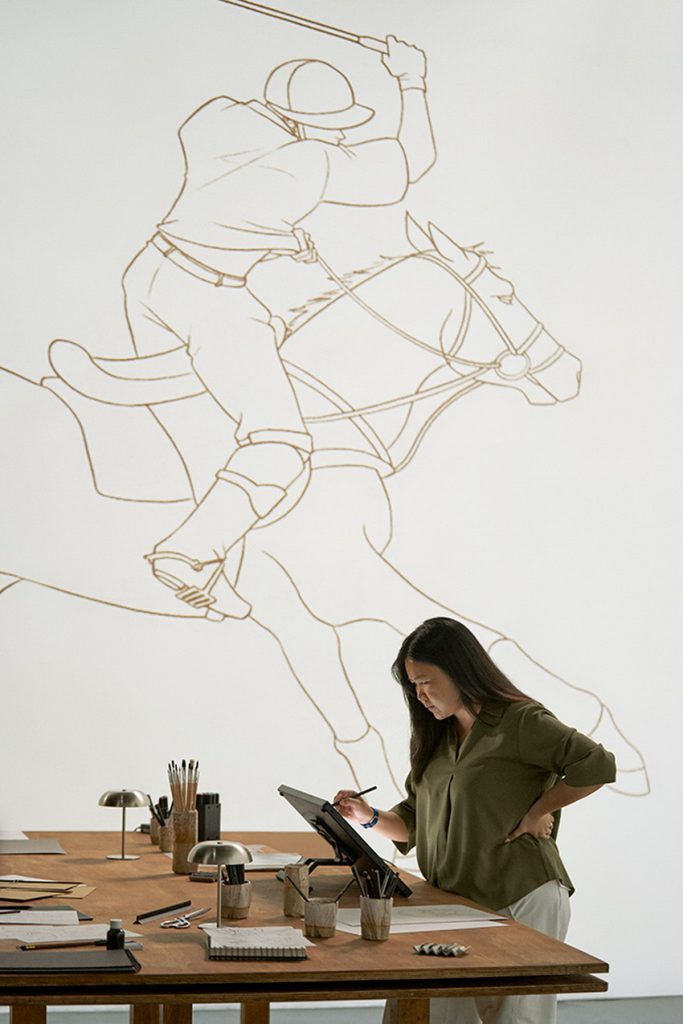
Jaeger-LeCoultre, through the Made of Makers project, has invited comic creator Olivecoat from Cebu, Philippines, to craft a six-chapter webcomic Reverso, transforming this watchmaking narrative into a digitally native storytelling format. This initiative aims to bridge the world of horology with various creative fields, having previously collaborated with visual artists, musicians, perfumers, and more to explore the dialogue between craftsmanship and contemporary expression. By incorporating comics this time, it effectively brings the medium known as Ninth Art into the realm of high-end watchmaking.

Comics, as a narrative form, have a history that is far older than one might think. From prehistoric cave paintings to medieval manuscripts, and the grid narrative experiments of Rodolphe Töpfer in the 19th century, comics have always been present. It wasn’t until 1964 that the term Ninth Art was officially introduced, paving the way for comics to be widely recognized as an independent art form. Today, webcomics thrive on mobile device platforms in a vertical scrolling format, with the act of reading itself becoming a part of the narrative rhythm.
Olivecoat gained recognition early on through Honbarian, featuring a gentle artistic style and vividly layered emotions in her characters. She once stated that when she first encountered Jaeger-LeCoultre, she wasn’t familiar with high-end watchmaking. This sense of distance actually allowed her to approach the narrative from a purer angle.
In Reverso’s comic, the narrative isn’t just a technical explanation but unfolds around the dynamics between the characters. César de Trey and Jacques-David LeCoultre emerge as the central figures. She once mentioned that in the illustrations, they engage in discussions, hesitate, and refine their ideas, showcasing the creative process rather than merely emphasizing the end result.
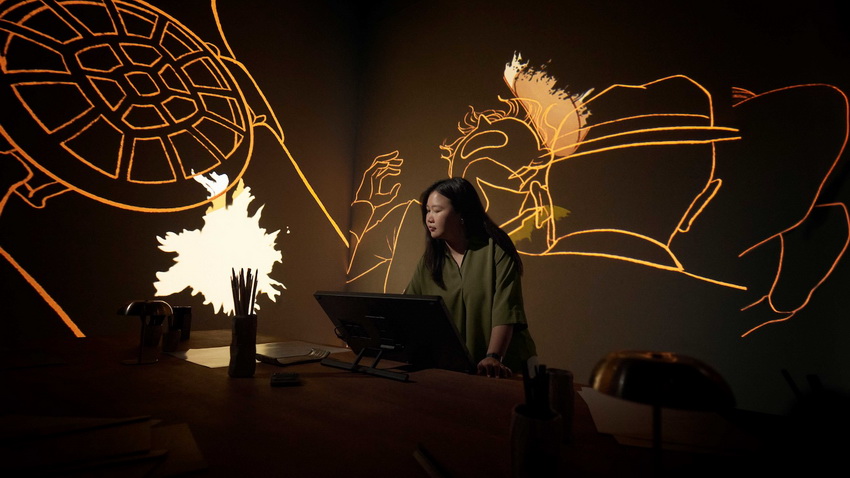
Both major scenes in the story are equally crucial.
The first scene unfolds on an Indian polo field. Horses gallop, kicking up dust, and the atmosphere is electric with energy. The second scene shifts to a grand workshop in Le Sentier, Switzerland. The lighting is calm, and mechanical parts are neatly arranged on the table. This contrast between movement and stillness symbolizes the transition between inspiration and technique. The way these scenes are orchestrated allows readers to intuitively experience the progression of space and time as they scroll through the visuals.
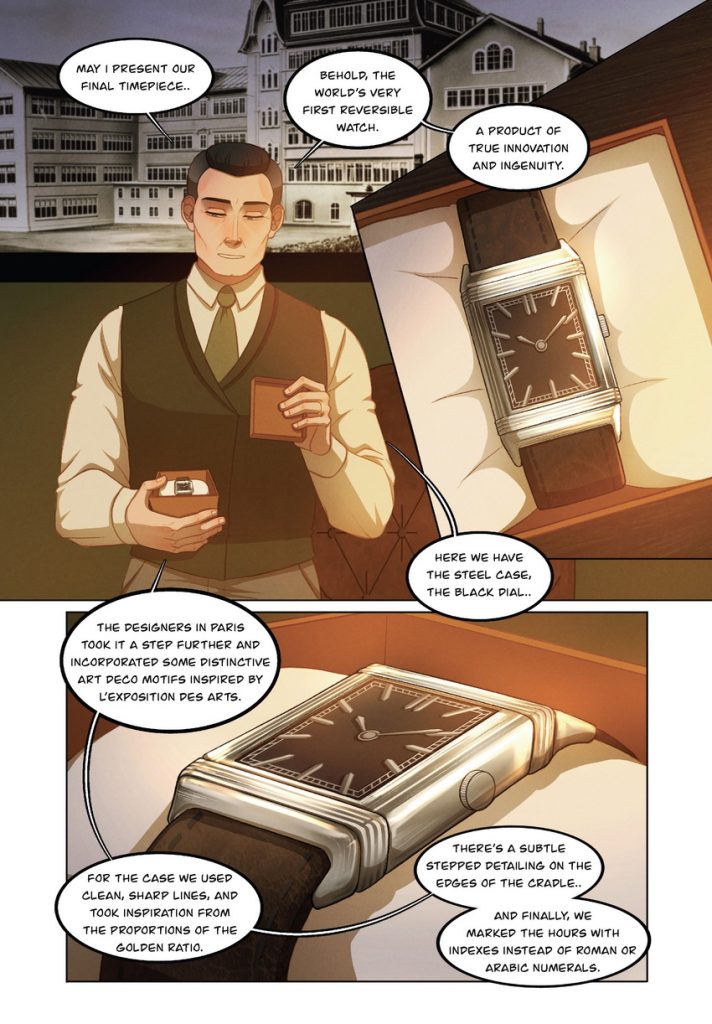
The vertical scrolling format is a key element of this creation. Unlike the traditional horizontal segmentation, this reading style allows the visuals to extend from top to bottom, creating a more fluid rhythm. With every swipe, the story moves forward a step. This feeling of Fingers pushing through time. resonates with the action of flipping the Reverso watch case. Flipping is a physical action, while scrolling is a reading action; together, they create a connection in the experience.
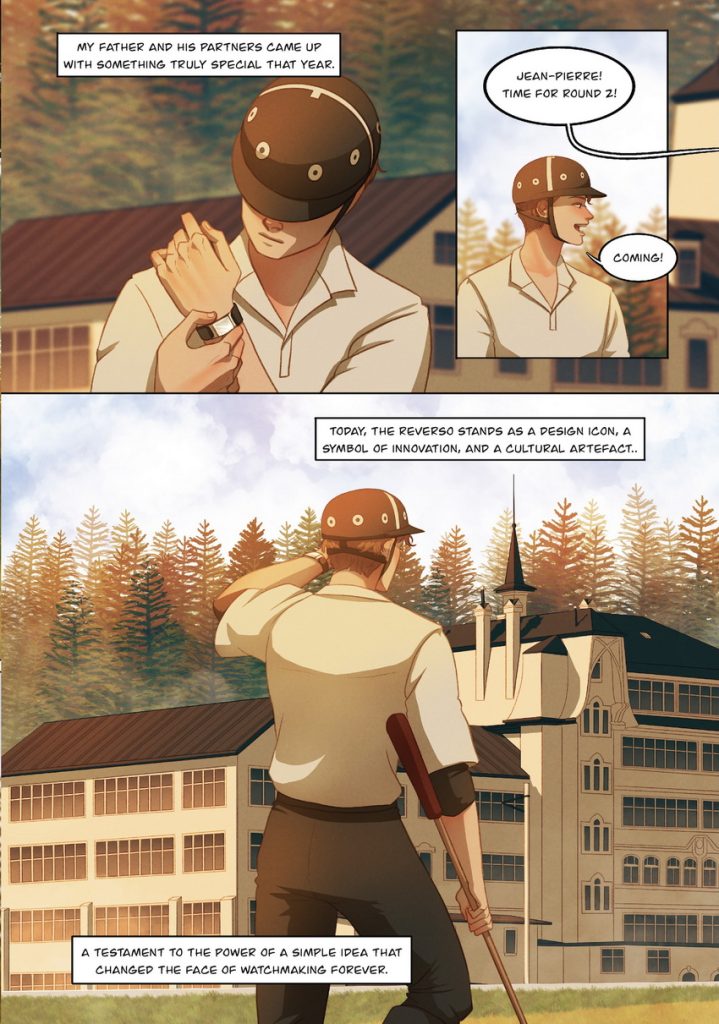
Olivecoat also mentioned that her artistic style has long been influenced by Asian comics, particularly appreciating that warm narrative approach. This gentle brushwork adds a layer of humanity to a history that leans towards engineering and structure.
Between mechanical watches and comics, there are actually many similarities. The movement calculates seconds through the balance wheel and gears, while comics advance their plots through panels and rhythm. Both emphasize structure, proportion, and detail, and both require long hours of dedication and repeated revisions. As she said, both forms of creation revolve around Focus and Polish.
Reverso has evolved through different eras while maintaining its rectangular silhouette and Art Deco elements. Its design language transcends time and continues to be reinterpreted across various versions. This time, the history is retold through a comic format, allowing this iconic timepiece to keep ticking away in a different medium.
The dust of the polo field, the gleam of metal in the workshop, and the conversations between individuals all intertwine within the frame. Reverso isn’t just a reversible design; it’s a narrative about discovering innovative solutions in the face of real-world challenges.

As readers swipe across the screen, the story moves forward. Time is no longer just the hands on a clock; it’s a journey of reading, imagining, and reinterpretation.
Complete webcomics can be viewed on the Jaeger-LeCoultre official website.