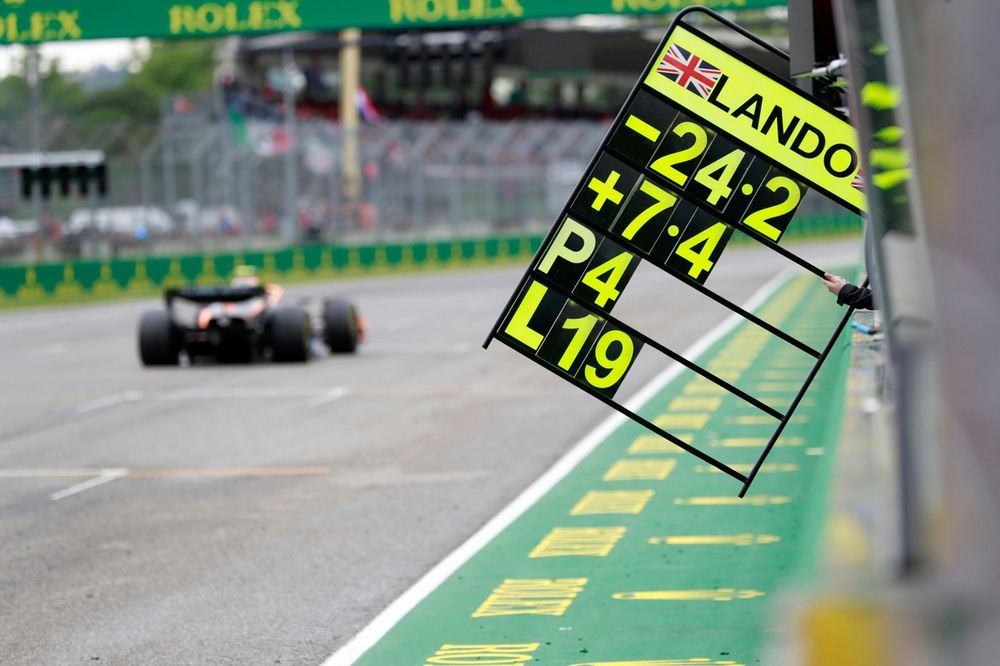
The pinnacle of motorsport — F1, often leaves a high-tech impression. In the past, wind tunnels were utilized to perfect car designs, while computational fluid dynamics were applied to create intricate wing components. Yet, despite teams having such advanced technology, why do they still choose to use the original method — the pit board to communicate important information to drivers?
During each thrilling Grand Prix event, the pit wall is a buzzing hub where engineers, strategists, and team executives come together to make various decisions in real time. Additionally, teams maintain direct communication with their drivers through radios integrated into their helmets, but that’s not the only way the pit wall connects with the racers.
The team will hang a supply board in the gap between the pit lane and the track fence, allowing drivers to quickly capture information while exceeding speeds of 200 miles per hour. These supply boards are made up of a simple frame, inside which letters and numbers can be rapidly swapped out, delivering instant data to the drivers.
These convenient supply versions help teams update the rankings of drivers during the race, monitor the distance between them and the vehicles behind, and crucially, track the time drivers need to catch up to outpace their opponents.
Despite the ubiquity of radio communication and the fact that race officials can even display messages directly on the steering wheel screens of certain cars, why does this relatively simple means of communication still exist? As a blog from Red Bull puts it: “Because the pit board doesn’t break.”
While radio failures are relatively rare in F1 today, there have been many issues in the past. Radio communication began being used by racing teams in the 1980s, and early on, Ayrton Senna experienced interruptions due to interference from the catering team on site. During the 1998 Australian Grand Prix, Mika Häkkinen lost his lead during a pit stop because of radio problems—McLaren later attributed the incident to a radio hack.
Although radio issues within the teams are now rare, they still occur from time to time. For instance, in 2021, Kimi Räikkönen had a heated exchange with his engineer due to his radio going silent; likewise, during the 2022 Canadian Grand Prix, Max Verstappen lost radio communication and was unable to respond to team instructions.
Therefore, the use of the supply board has become particularly important, allowing the team and the drivers to stay connected even when direct communication isn’t possible.
While these simple text messages may not compare to the guidance received by some drivers during a race, they at least help drivers understand their position in the race. In the event of a radio failure, the pit board can inform drivers when it’s time to pit for tire changes, whether they need to serve a penalty, or even simply how many laps are left until the race concludes.