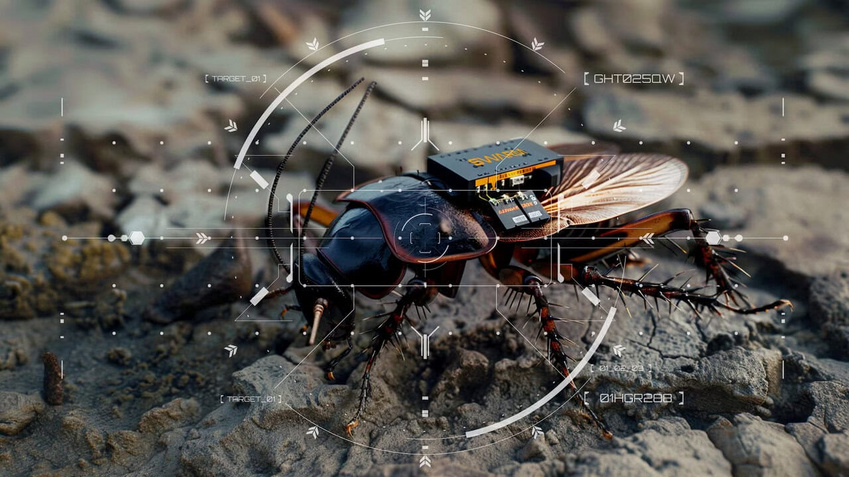
German military tech startup Swarm Biotactics has recently made waves by successfully developing an AI spy cockroach. This innovative technology involves equipping live cockroaches with tiny backpacks implanted on their backs, featuring cameras, sensors, and communication modules. Remarkably, these insects can be remotely controlled through electric stimulation to carry out military reconnaissance missions. This high-tech creation not only allows the cockroaches to move independently but also enables them to engage in group operations, specifically designed to gather crucial intelligence, such as enemy positions, in hostile environments.
Stefan Wilhelm, the president of Swarm Biotactics, pointed out that these bio-robots, which are based on live insects, can be equipped with nerve stimulation, sensors, and secure communication modules, enabling them to operate independently or autonomously engage in group combat. The specialized mini backpacks attached to them can collect real-time data via cameras, while the electrical stimulation system allows humans to remotely adjust the insects' movement directions and travel routes.
The aim of this technology is to enable spy cockroaches to provide real-time surveillance information in hostile environments, particularly in gathering vital military intelligence such as enemy locations. Thanks to their small size and resilience, these cockroaches can easily access tiny spaces that traditional reconnaissance equipment cannot reach, giving them a unique advantage on the battlefield. These biobots can infiltrate enemy positions, collect real-time tactical information, and quickly relay it back to command.
Annette Lehnigk-Emden, the head of the Bundeswehr Procurement Office, emphasized that drones and AI are emerging fields for Germany's future development. The introduction of this technology brings revolutionary changes to the battlefield, comparable in significance to the introduction of machine guns, tanks, and aircraft.
Since the Russian invasion of Ukraine, Germany's perspective on defense technology has undergone a complete transformation. Sven Weizenegger, the head of the Bundeswehr's Cyber Innovation Hub, noted that discussions around security issues in Germany have significantly intensified and become more open following this event. Nowadays, he receives up to 20 to 30 LinkedIn requests daily, many of which concern innovative ideas in defense technology, a stark increase from the 2 to 3 requests he received weekly in 2020.
In addition to Swarm Biotactics, Germany is home to several other startups developing similar cutting-edge technologies, including tank-like AI robots and unmanned mini submarines. These innovations are set to revolutionize the rules of future battlefields, challenging traditional military thinking like never before.