




HY World 2.0 from Tencent converts text, sketches, or video into editable 3D assets developers can run locally, addressing a major bottleneck in early 3D prototyping.
Tencent on its project page says the open source model, released as Hunyuan HY World 2.0, can produce editable hybrid assets that combine 3DGS, a Gaussian splat format, and mesh geometry with physical collision properties. The goal is to let designers skip much of the traditional low model to high model workflow and produce engine ready assets for rapid iteration.
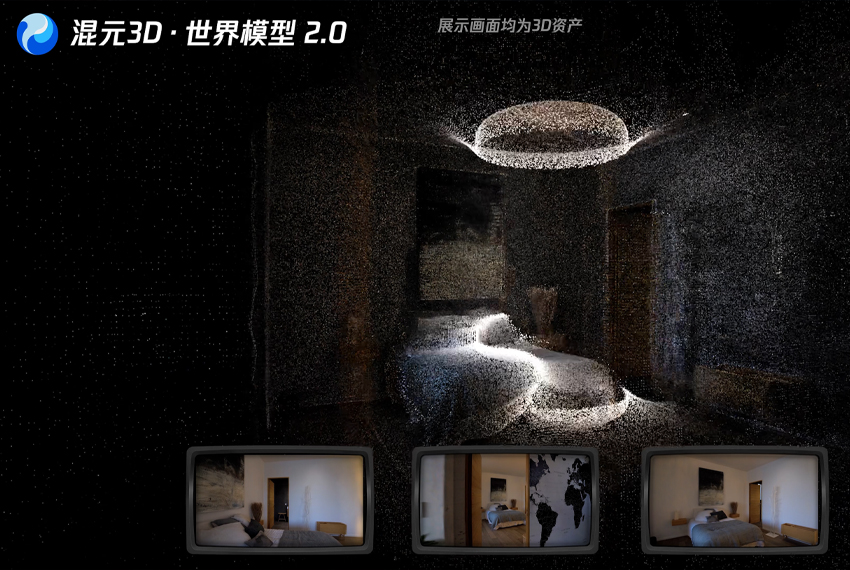
Key technical highlights at a glance
| Technical Specifications | Hunyuan 3D World Model 2.0 (HY-World 2.0) Specs | Practical Value |
|---|---|---|
| Input Modalities | Text, Single Images, Multi-view Images, Videos | Lowers the barrier to entry for preparing source materials |
| Output Formats | 3DGS, Mesh, Point Clouds, High-Quality Videos | Compatible with mainstream 3D software and game engines |
| Core Architecture | WorldMirror 2.0 Unified Forward Prediction Model | Enables prediction of depth and camera parameters in a single forward pass |
| Interaction Platform | WorldLens Rendering Platform | Supports automatic ambient lighting and character physics collision detection |
| Open-Source Status | Free and Open-Source Software (FOSS); Model Weights Released | Supports local deployment, safeguarding data and asset privacy |
How HY World 2.0 turns language into editable assets
In a traditional 3D development loop, artists move from sketches to low poly, to high poly, to texturing, to baking, then into an engine. HY World 2.0 compresses many of those steps into a new workflow designed for speed and iteration.
- Multimodal input (text, single image, multi view images, or video).
- HY Pano 2.0 panorama initialization, which auto synthesizes a 360 degree scene with no camera parameters required.
- WorldNav path planning, where AI parses scene geometry and semantics for obstacle aware camera paths.
- WorldStereo 2.0 view expansion, which uses stereo geometry memory to extend observational coverage.
- WorldMirror 2.0 world synthesis, a one shot predictor that outputs dense point clouds and 3DGS files.
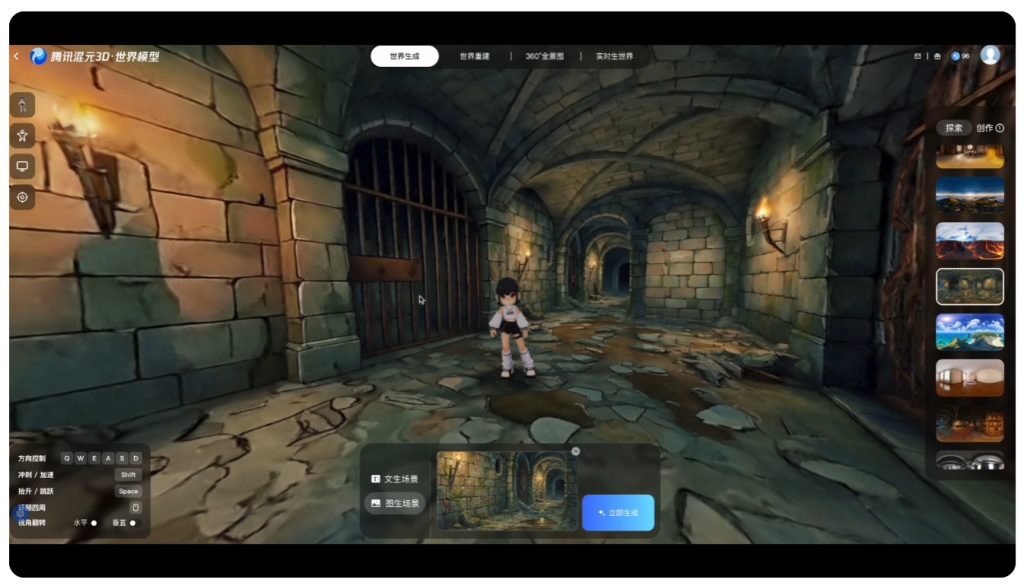
Developers need only supply a single descriptive sentence or a concept image and the system will synthesize a 360 degree panorama and rebuild a structurally coherent 3D file in minutes. Unlike 2D video generation, the resulting 3D assets have effectively unlimited render time and preserve spatial consistency when the camera rotates.
Four stage spatial reconstruction pipeline
Tencent designed HY World 2.0 to run efficiently on consumer hardware by splitting the process into four stages.
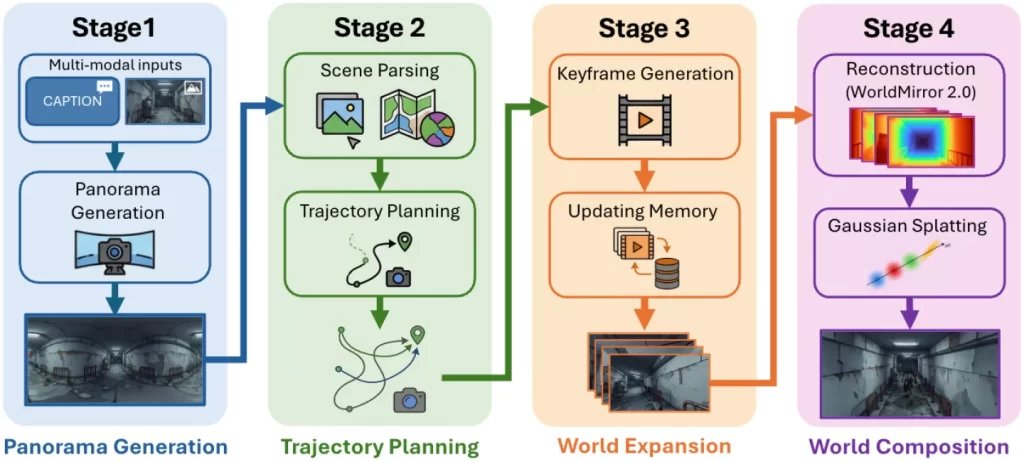
- Panorama generation, HY Pano 2.0, uses an end to end implicit learning approach so the AI can learn spatial mapping from a single ordinary image without camera metadata and still produce a background panorama.
- Path planning, WorldNav, automatically parses geometry and semantics to plan plausible camera routes while preventing physically impossible motion such as walking through walls.
- World expansion, WorldStereo 2.0, injects global geometric memory and stereo spatial memory along planned routes to ensure newly generated areas join existing regions both geometrically and visually.
- World synthesis, WorldMirror 2.0, is a forward predictor that in a single run estimates dense point clouds, depth maps, surface normals, camera poses and 3DGS attributes, stitching fragments into a unified 3D world.
Python API example
Developers can load a pretrained model locally with a few lines of Python and run the panorama module.
from pipeline import HunyuanPanoPipeline

pipeline = HunyuanPanoPipeline.from_pretrained('tencent/HY World 2.0')
output = pipeline('input.png')
output.save('output_panorama.png')
Interactive renderer with built in collision
Tencent also released WorldLens, a rendering platform that is engine agnostic and includes automatic image based lighting adjustment. The platform adapts diffuse and metallic response to the generated environment tone.
WorldLens includes a character exploration mode where users can move a virtual avatar with keyboard controls to test physical collision and scale. The system provides immediate physics feedback for actions such as climbing stairs or colliding with pillars, letting designers validate level proportions in seconds without complex collider setup.
How HY World 2.0 stacks up against competitors
Commercial world models such as Marble remain a benchmark in the space, but community feedback and developer reports say they often produce noisy meshes after converting 3DGS outputs into final geometry. Developers on GitHub and Discord have flagged cleanup as a common extra step.
Tencent says HY World 2.0 integrates a MaskGaussian cropping mechanism that filters out about 77 percent of redundant Gaussian points during reconstruction, producing cleaner exported mesh geometry and saving significant time on topology and polygon reduction. As an open source project, HY World 2.0 also allows full pipeline inference and finetuning on local GPU servers, which Tencent and users say improves data control for sensitive projects.
Technical limitations to consider
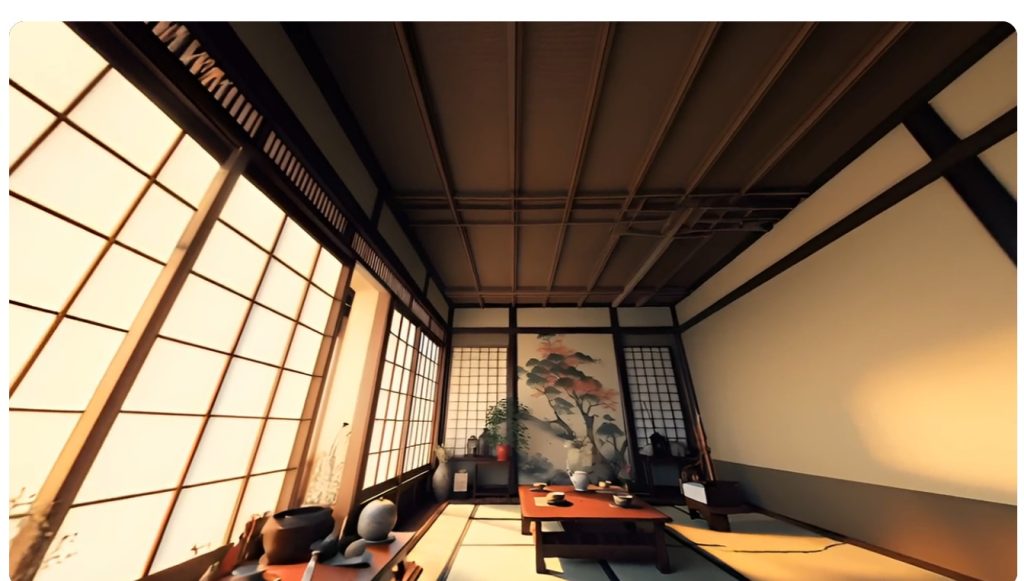
Despite advances, HY World 2.0 has two clear limitations in production contexts. First, scenes are non instanced, meaning the system generates a fused scene mesh rather than separate, selectable props.
- Non objectized scenes, where objects such as chairs are welded into walls and floors at the mesh level, so you cannot select and move a single chair inside a modeling tool. This makes the tool more suitable for distant set dressing and environmental prototyping rather than high interaction levels for final game assets.
- Phased code release, the open source repository currently exposes WorldMirror 2.0 and HY Pano 2.0 code and weights, while the full four stage orchestration code is being released progressively. Achieving a one click, fully local text to complete world pipeline may still require community transition scripts.
💡 Technical tip: Tencent says WorldMirror 2.0 supports flexible inference resolutions from 50,000 to 500,000 pixels. If local GPU VRAM is limited, deploy a mini model configuration to reduce memory use during rollout.
HY World 2.0 moves the world model concept from recording a video like snapshot to constructing a playable 3D file. For independent game studios, multimedia schools and virtual production teams, the model can substantially lower the cost and time to build early scene concepts.
While it is not yet a one stop solution for final release quality assets that require separately selectable props, as a low cost, high speed prototyping tool it advances the starting line for many creators.